ENCOD_Flyer_P1

ENCOD at the #CND69


Press release

Vienna, March 5th 2026

ENCOD at the #CND69


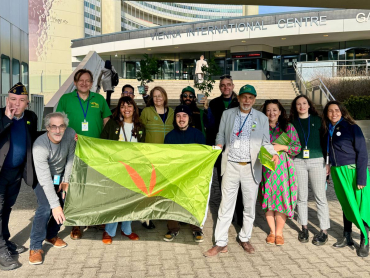
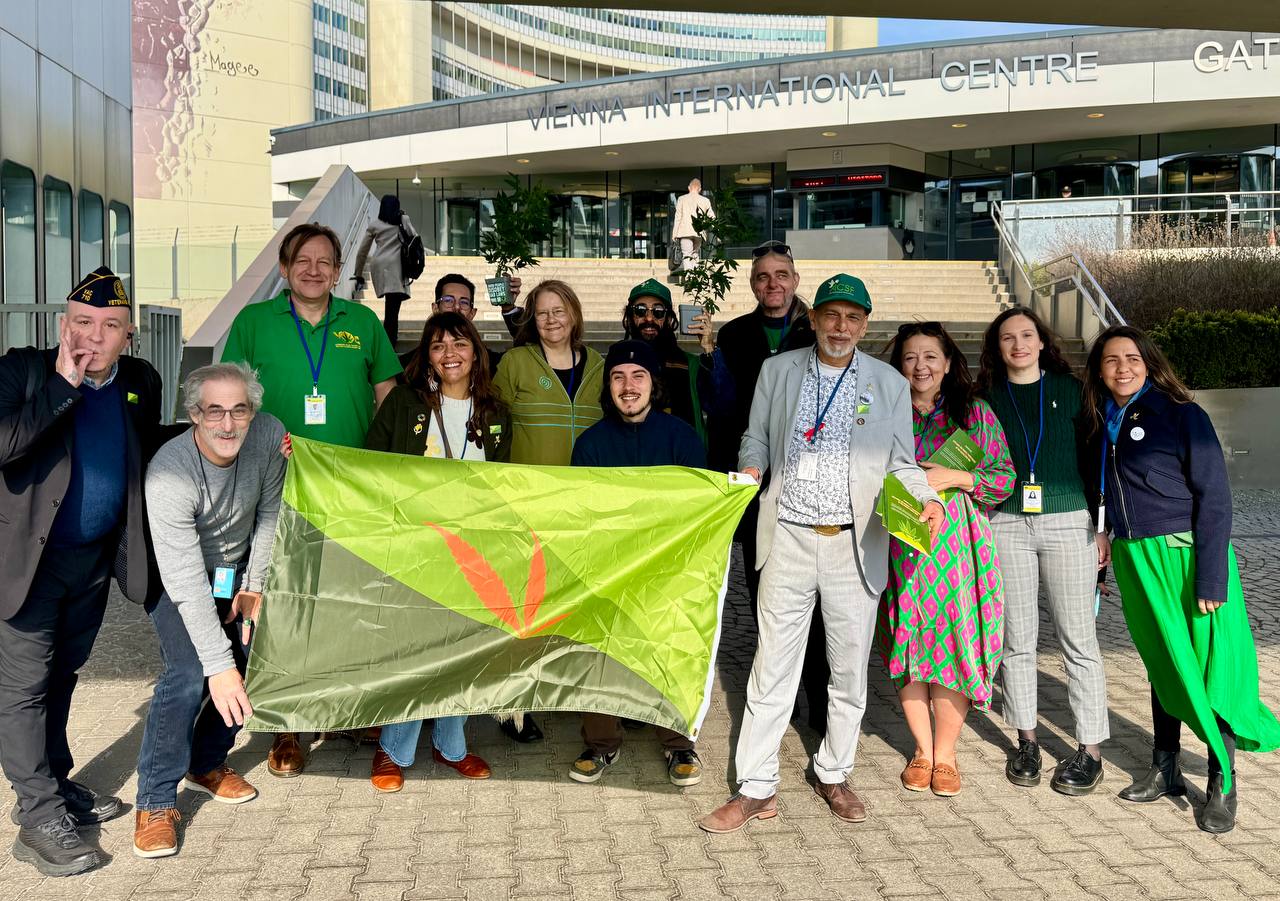
ENCOD’s delegation to CND69 in Vienna from Monday 9th to 13th will be huge. 

With 31 members, we hope to show that our community is concerned and that we need to meet policymakers to achieve changes.


CND69 challenges

The 69th session of the Commission on Narcotic Drugs, from March 9th to 13th, will address a variety of challenges: With the “Vienna Consensus” no longer in place because the United States is demanding a vote on every resolution that mentions “gender issues” and the United Nations’ “Sustainable Development Goals,” the debates are sure to be heated.

The first two resolutions will attract particular attention as they deal with the same issue, although the first, proposed by Mexico, is much more serious in content, while the second, presented by the United States, appears much more problematic in its wording and objectives.

The third resolution concerns “alternative development” and follows on from previous resolutions adopted at each session. However, even on this one, the US will call for a vote.


The fourth is presented by Kyrgyzstan (perhaps supported behind the scenes by Russia) and seems to complement the first resolution and counter the second with its seriousness. 


The fifth resolution, presented by Finland and Norway, is very ambitious and the most interesting from the point of view of civil society organisations. 


It is clear that, as last year, the Committee of the Whole (CoW) will have to conduct lengthy negotiations to finalise the content of the five resolutions submitted for vote at the 69th session of the CND, votes in the Plenary that promise moments of “epic fury” in the UN buildings in Vienna (where the IAEA for nuclear energy and the UNODC for drug control are based).


Among other topics addressed at this 69th session of the CND, the WHO recommendation on coca leaf will not be voted on, as it does not provide for any change in the scheduling of coca leaf, as ENCOD already indicated in its statement at the 48th ECDD (WHO Experts Committee on Drug Dependance) briefing. It will nevertheless be interesting to follow the discussions between Member States during the Plenary closely. We’ll pay attention to the Colombian exhibition in the Rotunda, the heart of the VIC. 


With a busy agenda, including a side event every day, two demonstrations (on Monday and Thursday) at the entrance to the VIC, the Première of a European tour of the exhibition,   https://frenchdutchparadox.org/, and numerous other interventions, both with oral statements in the Plenary and by asking questions during informal dialogue with representatives of UN agencies meetings… Encod attempts to keep its strong commitments at the highest level.


Civil Society Delegation


ENCOD delegation will be more than 30 people, and more than 15 countries, representing: Associacao de Apoio a Pesquisa e Pacientes de Cannabis medicinal (ACURA), Cannabis Cura Sicilia, Cannabis Embassy, Cannabis Sans Frontières, Cannabis sem Fronteiras, DRCnet Foundtion, For Alternative Approaches to Addictions Think&Do tank – Forum Drogues Mediterranée (FAAAT-FDM), Fields of Green For All, Law Enforcement Action Partnership (LEAP), Multidisciplinary Association for Psychedelic studies (MAPS), Nonviolent Radical Party, Santo Amor – World Movement for Cannabis Freedom Club, Verbond voor Opheffing van het Cannabisverbod (VOC), Veteran Action Council (VAC). 


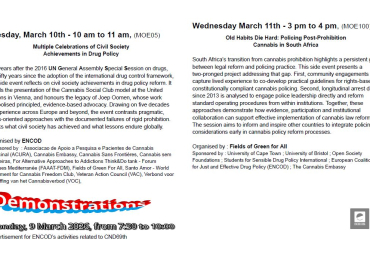
DEMONSTRATIONS


Monday, 9 March 2026, from 7:30 to 10:00.
Advertisement of ENCOD’s activities related to CND69th.

Thursday, 12 March 2026, from 7:30 a.m. to 3:00 p.m. It will consist of an exhibition wall with a small display case with artefacts and a decorative birdcage with a clone, symbolising the long struggle for Freedom to Farm.


EXHIBITION 

Pragmatism vs punishment: which is more effective? 

After 50 years, the remarkable paradox between two founding members of the EU serves as a striking empirical record of successful, pragmatic strategies versus failed, rigid policies.

Following its Vienna debut, the exhibition will travel around Europe in seven countries and nine cities – Bilbao, Berlin, Paris, Brussels, Prague, Amsterdam, The Hague and Eindhoven.

Visit: https://frenchdutchparadox.org/


SIDE EVENTS (slight program of the week at the UN)

Tuesday, March 10th – 10 am to 11 am, (MOE05) 

Multiple Celebrations of Civil Society Achievements in Drug Policy

Follow online : https://us02web.zoom.us/j/81897668686

Wednesday March 11th – 3 pm to 4 pm, (MOE100)

Old Habits Die Hard: Policing Post-Prohibition Cannabis in South Africa

Wednesday, March 11th – 11:30 am to 12:30 pm (MOE07)

War on Drugs and Systemic Corruption : Unintended Consequences

Friday, March 13th, 11:30 am to 12:30 pm (M5)

CBD-Rich Cannabis – Policy and Patient Experience Hybrid 

PRESS RELEASED ENCOD AT CND69_VF


ENCOD_Flyer Page

Exhibition Website frenchdutchparadox.org

Travelling exhibition on French/Dutch cannabis paradox to premiere at United Nations in Vienna


VIENNA – A new travelling exhibition comparing the divergent cannabis policies of France and the Netherlands will premiere in Vienna on March 12, coinciding with the annual meeting of the UN Commission on Narcotic Drugs (CND).

The year 2026 marks a dual 50th anniversary: the birth of the Dutch tolerance policy for cannabis, which paved the way for their world-famous coffeeshops, and the publication of ‘L’Appel du 18 Joint’, a plea by a group of prominent French citizens for decriminalization of cannabis.

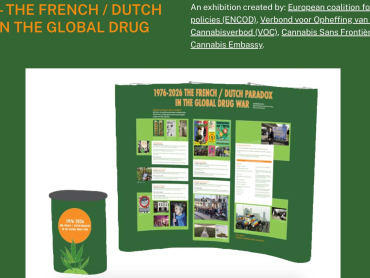
The exhibition, ‘1976-2026 – The French/Dutch Paradox in the Global Drug War’, explores half a century of cannabis policy within these two founding members of the European Union, contrasting pragmatic regulation with rigid prohibition.

Visitors can trace the evolution of the Dutch model, up to the current experiment with regulated cannabis cultivation, supplying around 80 coffeeshops. The contrast with France is stark. The 1976 appeal has evolved into a French “420”, with demonstrations for legalization all over France on June 18. Yet the law remains strict and repression persists. Despite decades of criminalisation and mass arrests, France continues to see the highest cannabis consumption rates in Europe.

What’s on display? The heart of the exhibition is a narrative wall featuring photos, illustrations and English texts. A display case contains historical artefacts depicting Dutch and French cannabis culture. There’s a live cannabis plant in a cage and a section dedicated to the late Joep Oomen (1961-2016), drug reform activist extraordinaire and co-founder of NGOs Encod and stichting VOC.

The project is a collaboration between Encod (European coalition for just and effective policies), stichting VOC, Cannabis Sans Frontières, FAAAT and the Cannabis Embassy.

Nine cities in seven countries

Following its Vienna debut, the exhibition will travel to Bilbao, Berlin, Paris, Brussels, Prague, Amsterdam, The Hague and Eindhoven. The goal is to show it in nine cities in seven countries. Leaflets with translations of the exhibition texts in five languages are available, as well as a comprehensive 24-page guide featuring further information and imagery.

Vienna: March 12

The exhibition will be stationed in front of the Vienna International Centre (VIC) on Thursday March 12. Board members from Encod and stichting VOC will be on site to talk to visitors, international delegates and journalists.


Website: www.frenchdutchparadox.org

Gaby Kozar, Encod coordinator (Vienna): gaby@encod.org Phone: +43 699 123 790 86

More information: www.voc-nederland.org


THE FRENCH / DUTCH PARADOX IN THE GLOBAL DRUG WAR 

LaLineaTrump

ENCOD POST – Educate Not Lie #1

ENCOD post – Educate not lie #1


With the New Year 2026, ENCOD wants to share our Food for thought, that we name: “ENCOD post – Educate not lie”.

Food for thought

Download : ENCOD Post – Educate not Lie #1

By Encod Post, february, 4th 2026

We wish you the best 2026 you can have.

This year is of very big challenges for ENCOD, ten years after the UNGASS on drugs which occurred one month after Joep Oomen deceased on March 18th, while the day before, the Cannabis Social Club model was presented at the UN in Vienna.

Ten years later, countries like Malta and Germany have legalized such clubs, even if these often overlook a key element of Joep’s vision: 

By prohibiting on-site consumption, these laws strip the clubs of their essential “social” function which is providing a safe, shared space for consumption, an essential part of Harm Reduction.

A decade after his passing, Joep’s dedication and vision remain an inspiration to drug reform activists worldwide, as you’ll read it in the Minutes of our last Général Assembly in Eindhoven, Encod stands firm in its commitment to promote just and effective drug policies rooted in human rights, public health and social equity. 

What lies ahead

A whole series of celebrations lies ahead of us. In addition to the 50th anniversary of the Franco-Dutch paradox in the global war on drugs, the particular paradox between two founding members of the EU impressively underscores the empirical evidence for successful, pragmatic strategies as opposed to failed, rigid policies. We are aiming to tour   Europe with an exhibition and would like to present it in various cities and countries. Please let us know if you’re interested in participating in this important initiative.

Drugs and Driving:

ENCOD has established a dedicated working group on cannabis and driving, involving representatives from several EU countries. The group’s main objective is to address the challenges related to current detection levels and testing practices across Europe. There is a need to reassess existing thresholds, as many drivers face penalties such as losing their licenses due to detection windows that can extend up to three days after consumption, an approach widely viewed as disproportionate and unfair. This also applies to cannabis patients. The group will collaborate to propose fairer, evidence-based standards that better reflect actual impairment rather than mere presence of cannabis in the system. We’re aiming to organize a European Conference in September 2026, focusing on the topic of cannabis and driving. The event will bring together experts, policymakers, and stakeholders from across Europe to discuss the implications of cannabis use on road safety, legal frameworks, and scientific research related to impairment and testing.

Please let us know if you’re interested in participating in this important initiative.

European Network of Cultural Organisations on Drugs

Encod among the Cannabis Embassy are willing to work hard to change the narrative about cannabis from “hard prohibition” to “cannabis as a solution”.

In Barcelona, during the last MONDIACULT (world’s largest conference on cultural policy), a delegation of cannabis activists met official delegates to raise our argument about the sociocultural aspect regarding the consideration of cannabis as an Intangible cultural heritage of humanity. This is a call to all the driving forces from different countries to do the Intangible Cultural Heritage (ICH) process, an open consultation process, to the social movement and all cultural organisations related to cannabis. Please contact us if you are interested in joining this initiative. 

Among other projects

  • Cannabis Fair Trade from Morocco: The idea is to create a project to export cannabis in a fair trade relationship from Morocco to the Netherlands.
  • Consumption Site in Vienna/Smokers’ Club: The idea is to create a place where CBD consumers could consume CBD, a smoker’s social club, where ENCOD could also have a place to be.
  • EU NGO “Grow your rights”: Creating a European NGO for defending the rights of people prosecuted for cannabis offences. (In relation with the The Last prisoner project lead by Steve De Angelo : https://stevedeangelo.com/last-prisoner-project/)


Global Drug Policy overview

Legal regulation in the Czech Republic

The year begins with very good news from the Czech Republic, which is introducing a legal framework for cannabis. The Czech reform follows similar legislation to that passed in Germany in 2024, although the two countries differ in several respects. Authorities have described the current phase as focused on personal cultivation rather than shared or commercial use, explaining that allowing home cultivation could reduce demand for unregulated or synthetic cannabinoid products. This innovative framework aims to reduce legal uncertainty while easing pressure on courts, prisons, and police. The new law marks a significant change in Czech drug policy, which has previously relied on a combination of decriminalization thresholds and discretionary prosecution.


Czechia (2026): Minimum age 21; up to 3 plants at home; up to 100 g at home, 25 g in public; cannabis clubs not yet legal, no retail sales.

Germany (2024): Minimum age 18; up to 3 plants at home; up to 50 g at home, 25g in public; non-profit cannabis clubs legal, no retail. 

Luxembourg (2023): Minimum age 18; up to 4 plants per household; home possession legal; 3 g in public; no sales, private use only. 

Malta (2021): Minimum age 18; up to 4 plants per household; up to 50 g at home, 7g in public; non-profit cannabis social clubs legal (limited to 500 members); no sales

Netherlands: Minimum age 18; home cultivation illegal (limited pilots underway); small amounts decriminalized; public possession decriminalized; retail tolerated in coffeeshops. Ongoing supply chain experimentation in ten Cities.

Spain: Personal cultivation decriminalized; cannabis social clubs exist in some regions; public possession and sale are technically illegal. 

NPS and other threats

We must be aware that prohibitionists never run out of new conceptual threats. After the complete failure of the “war on drugs” at the end of the 20th century, “narco-terrorism” is now emerging as a brand-new linguistic element for the 21st century, serving law enforcement agencies (and their financial support). As commented by Pierre-Arnaud Chouvy, It’s easy to denounce a threat that doesn’t exist, even more so when most people won’t test the concept of the threat itself. Ultimately, denouncing so-called narco-terrorism is a scare tactic and an ideal smokescreen”.

This neologism can conceal many things, from the events in Venezuela with the kidnapping of the head of state to the new concerns raised by some NPS, especially opiate-based drugs, but also cathinones, cannabinoid mimetics with hundreds of molecular formulas.

Behind “drug terrorism” lies a new kind of music played with weapons of mass destruction (WMD) to stir up fear. But, as Steve Rolles noted in his blog,Designating fentanyl as a WMD has nothing to do with drug control – and won’t work as a form of drug control even if it did. In a similar fashion to the recent designation of some drug cartels/organised crime groups as ‘terrorist organisations’, this latest move is more than just drug war machismo. It’s a very deliberate strategy to justify punitive domestic policing and overseas military interventions by triggering access to emergency, anti-terror and wartime powers. It’s a way of consolidating executive power”.

Coca leaf

Last December, during the 68th CND reconvened session, WHO presented 48th ECDD recommendations on coca leaf. With no surprise for ENCOD, as we clearly stated  in our contribution to the ECDD review information meeting, WHO has no other recommendation than to keep Coca leaf in the schedule 1 of the Single convention on narcotic drugs.

As we declared in our statement to the information session of the 48th ECDD “However, it is imperative to recognise that under the Convention’s current structure, an effective descheduling of the coca leaf from Schedule I is legally and institutionally impossible without a formal amendment to the treaty itself.

The coca leaf (Erythroxylon Lam.) holds deep cultural, medicinal, and nutritional importance for Indigenous and Andean communities. Nevertheless, since 1961 it has been treated under international law as equivalent to its extracted alkaloid, cocaine. This conflation is not incidental: coca, together with opium and cannabis, forms one of the three botanical pillars upon which the Convention’s classification system is built.”

Then, as for Cannabis five years ago which still remains in schedule 1, there is no possibility to change the scope of the plants that are at the core of the whole drug control system. Again, for Coca leaf as well as for cannabis, we can always argue that this international framework is inherited from the colonial grip on resources, only for the benefit of the pharmaceutical industry, but we must think out of the box of a long misunderstanding of the real purpose of the UN conventions on drugs.

Thanks to this very interesting essay published by FAAAT edition, the same analysis can be conducted on coca bush and coca leaves. What should be loudly supported is that the international drug control conventions contain a dichotomy of “medical purposes” vs “non-medical purposes” in the text of the 1961 Single Convention (C61)

 “health and welfare of [hu]mankind.”

create a legal landscape where State Parties can legally regulate the production and use of Coca leaves products for non-medical use, under Article 2(9). 

Article 2(9) offers each sovereign member state bound to the Single Convention, a legal ground to legalize coca leaves “de lege lata (or lex lata: without the need for a change in the law as it is currently) under fairly precise establishing provisions.

There are only two obligations, also compliance mechanisms:

  • According to the preamble (object and purpose) and Art. 2(9)(a), Art. 38 (prevent abuse of coca leaves) and Art. 27(2) (additional provisions relating to the coca leaves):

⇒   Any government, as a member state, can decide to adopt dispositions that ensure that non-medical Coca leaves products are safe and minimally harmful, and reduce the burden of substance use disorders (SUD/abuse) or to otherwise undermine public health and welfare –by any mean that is appropriate, in good faith (it can be denaturation, but it can also be other means of harm reduction)

  • According to Article 2(9)(b) and Article 20(1)(b):

⇒  All governments, as a member state, [if it has decided to exempt coca under art 2(9), must] send annually the amount of non-medical coca leaves in the legal industry, to the INCB via Form C Part II.B.

In addition, the government, as a member state would need to maintain a separation between medical purposes (healthcare, pharmaceutical and research sectors) and the non-medical coca leaves industry (adult use and industrial coca leaves sectors), in order to comply with Article 4(c) and 27(1) & (2).

In practice, this does not affect the performance of other treaty provisions under the C61 and does not affect other Parties (except w.r.t the specificities of EU internal market). The interpretation is not binding on the States having disagreed to it. 


New expert group to be appointed

Last march, a resolution held by the Colombian delegation was adopted at the 68th CND. It calls for an independent expert group to be appointed, under the auspices of the UN Secretary General, to scrutinise the global drug control system and make recommendations for its more effective implementation. 

The panel will be composed of 19 members: ten selected by the CND and its regional groups, five appointed by the UN Secretary-General, three by the International Narcotics Control Board (INCB), and one by the World Health Organization (WHO). An update on the progress made in establishing the panel will be presented at its sixty-ninth session in 2026 and a discussion of the panel’s recommendations will occur at its seventieth session in 2027; with a view to contributing to the review to be conducted by the Commission in 2029.

At the reconvened 68th session, last December, part of the panel was presented, but four seats remain to be filled.  This situation will certainly lead to delays and could hamper the work of this independent expert group.  

Another major hurdle will be ensuring the review is funded as member states will need to provide extrabudgetary resources. As the threshold set by the EBM has been met, the panel will be established, but to date, a little more than half has been pledged. 

Such an independent expert group to be convened within the UN system has actually been a long standing strategic goal for many, as ENCOD, in the reform movement that dates back to before the 2016 UN General Assembly Special Session on Drugs.

Will this expert group conclude that it is necessary to create a new global framework for the international drug control system, based on 21st-century scientific knowledge and the lessons learned from the past mistakes?


CND68th and its reconvened session

Regarding the CND68th and reconvened session last December, votes are clearly pulling apart US and Argentina.

In favor: Argentina, United States 

Not in favor: Bangladesh, Austria, Australia, Algeria, Indonesia, Guatemala, France, Finland, Colombia, China, Canada, Brazil, Armenia, Hungary, Ghana, Dominican Republic, Chile, Belgium, United Kingdom, Thailand, South Africa, Republic of KoreA, Nigeria, Morocco, Mexico, Japan, Italy, Cote D’Ivoire, Switzerland, Spain, Slovenia, Singapore, Russian Federation, Portugal, Poland, Peru, Kingdom of Netherlands, Malta, Lithuania, Kenya, India, Uruguay. 

Abstentions: no abstentions.

Summary – Reconvened 68th Session of the CND (5 Dec 2025): more info on https://cndblog.org 

  • The session opened with the adoption of the consolidated budget for 2026-2027 following informal consultations and approval by silence procedure (Vienna consensus). 
  • The Commission then moved to endorse the FinGov Bureau for 2026, with nominations from regional groups: Mexico for Chair, Morocco for Vice Chair, and Iran for another Vice Chair position. 
  • The United States objected to Iran’s nomination, arguing it was incompatible with service on a UNODC body, and called for a vote rather than automatic endorsement. 

The United States opposed the nomination of the second secretary of Iran’s permanent mission to serve as Vice Chair of FinGov and has called for a vote on the candidacy. The U.S. argued that Iran’s involvement, through the Islamic Revolutionary Guard Corps and the Quds Force—designated terrorist organizations—in terrorism and narcotics trafficking is incompatible with service on any UNODC body. Granting Iran a leadership role would, in the U.S. view, legitimize destabilizing behavior and undermine the integrity of FinGov. The United States therefore urged Commission members not to support the Iranian candidate and requested that this position be reflected in the meeting report.

Iran argued that there is a long-established procedure under which regional groups decide their own nominations, and that it is inappropriate for delegations from other regions to challenge those decisions. Iran warned that allowing such interference would set a dangerous precedent, undermine established practice, and weaken the authority and credibility of the Commission’s rules. Emphasizing adherence to the rule of law rather than arbitrary decision-making, Iran urged members to reject any challenge to the regional nomination process and, if a secret ballot was held, to vote in favor of the Iranian candidate.


  • After procedural discussion, the chair confirmed the first two nominations by acclamation, and the Commission held a secret ballot on the Iranian nominee. 
  • In the secret ballot, the Iranian candidate was elected Vice Chair of FinGov with the required majority of votes.

Total number: 44. Invalid: 1. Valid: 21. Abstentions: 22. Members present and voting: 21. Majority required was 11. Results: Iran received 21 votes. The candidate obtained necessary majority and elected as vice chair of FinGov. 

  • The session then discussed follow-up to the 2019 Ministerial Declaration commitments, including national responses to drug consumption, harm reduction strategies, and alternative development, with contributions noted from Thailand (intend to table a resolution at the 69th session, building on existing guiding principles), Morocco (respond to the challenges of drug consumption and drug use, integrating prevention, treatment and harm reduction into their national mental health plans), and Peru (need for more inclusive alternative development: present in the form of a conference room paper as well as in a resolution for adoption by members at the CND 69th, including the proposal for additional guiding principles). 
  • OHCHR: Human rights issues related to drug policy were highlighted, including concern over the use of the death penalty for drug offences, with calls for moratoria and abolition in line with international law. 
  • The provisional agenda for the 69th CND session was adopted, including dates (9–13 March 2026, pre-session 7 March), and objections by the U.S. and Argentina urge deletion of the words “including follow-up to and review and implementation of the 2030 Agenda for Sustainable Development“. 
  • Under “Other Business,” several delegations debated the issue of unilateral coercive measures (sanctions), prompted by the commemoration on December 4th of the UN International Day Against Unilateral Coercive Measures.

Venezuela, Russia, Iran, China, Cuba, and others argued that unilateral coercive measures violate international law, the UN Charter, international humanitarian law, and the right to development. They described such measures as instruments of economic warfare that harm civilian populations, restrict access to food, medicine, finance, and technology, undermine development, and disproportionately affect developing countries. These delegations called for the immediate and unconditional lifting of all unilateral coercive measures and urged states not to recognize or implement them, emphasizing multilateralism, international cooperation, and adherence to General Assembly mandates. 

In contrast, the United States, Canada, Australia, the United Kingdom, and France rejected the characterization of autonomous sanctions as illegal. They argued that sanctions can be lawful, legitimate, targeted, and necessary foreign policy tools to address serious threats such as terrorism, human rights violations, corruption, proliferation of weapons of mass destruction, and threats to international peace and security. These delegations stressed that sanctions are not punitive, include safeguards and humanitarian exemptions, allow for legal review, and aim to change behavior. France and others also expressed concern that the CND was not the appropriate forum for this debate and warned against conflating unlawful measures with sanctions that are consistent with international law and the UN Charter.

Overall, the exchange highlighted a deep divide among Member States over the legality, legitimacy, humanitarian impact, and appropriate forum for discussing unilateral sanctions within the UN system.

  • The Chair’s initiative on a policy-to-practice compendium of national experiences was introduced, and the report of the session was adopted. 
  • Finally, the 69th session chair and bureau were introduced, with Andranik Hovhannisyan, Armenia’s Permanent Representative nominated and approved as Chair.

Under the Trumputinism hammer

Within its borders, the Trump administration is continuing its mutation to a neofascist-authoritarian shift. On January 6, the Senate confirmed Sara A. Carter Bailey as the new “drug czar,” the colloquial title for the director of the Office of National Drug Control Policy (ONDCP), by a vote of 52-48. The former Fox News contributor was nominated by President Donald Trump in March 2025 and is the first woman to lead the ONDCP. She will likely use the position to amplify fentanyl misinformation and conspiracy theories targeting immigrants. “Under [Trump’s] leadership, we will reassert our fundamental right to live healthy lives”, Carter stated following her confirmation. “We will hold accountable the narco-terrorists who infringe upon this right, participating in the deliberate poisoning of tens of thousands of Americans each year. They will no longer kill our families, friends, neighbors, and even children with impunity. At the same time, I will ensure that every parent, family member, and child has the resources they need to prevent and combat addiction. I will stand with our brave law enforcement officials, and with every family who has lost a loved one to drug overdose”.

At the UN level, the Trump administration is opposing all resolutions recalling UN wording about  “Gender issues” and all mentions of “implementing the 2030 Agenda for Sustainable Development”. The United States objects each time they read a reference to the “2030 Agenda and the Sustainable Development Goals”, citing principled concerns with that framework. Each time the US requests that this position be reflected in the meeting notes and calls for a vote on this amendment. Generally, Argentina follows the same argument and fully supports the U.S. proposal, emphasizing that the 2030 Agenda is non-binding, that states retain sovereignty over its implementation.

Last but not least, weakening the UN

White House decision titled “Withdrawing the United States from International Organizations, Conventions, and Treaties that Are Contrary to the Interests of the United States” Presidential Memorandum, 7 January 2026: The President directed a broad review of all international intergovernmental organizations, conventions, and treaties to identify those deemed contrary to U.S. interests. Based on that review, the United States will withdraw from 66 international bodies, treaties, and conventions—including both non-UN organizations and numerous United Nations entities—by ending U.S. participation and funding to the extent permitted by law. The list includes major treaties and organizations such as the UN Framework Convention on Climate Change (UNFCCC), the Intergovernmental Panel on Climate Change (IPCC), and a range of environmental, development, and governance bodies. All executive departments and agencies are directed to take immediate steps to implement these withdrawals. 

The memorandum reflects a policy of prioritizing U.S. national interests and reducing engagement with institutions viewed as advancing global agendas that conflict with those interests. 

  • Critics and international officials have described the move as a significant retreat from global cooperation, especially on climate, environment, development, and human rights issues. 
  • There are also legal questions about whether the President can unilaterally exit certain treaties that were ratified with Senate approval, such as the UNFCCC.


Next places to meet

19 February 2026

https://cannabis-europa.com/

9 – 13th March 2026

https://www.unodc.org/unodc/en/commissions/CND/session/69_Session_2026/Main.html

13-15 April 2026

https://internationalcbc.com/berlin/

17-19 April 2026

https://spannabis.es/bilbao/en/home/

24-26 April 2026

https://konopex.cz/en/


18A77A2D-13AC-4BB9-A5E0-93BC817E5D4A

Minutes of ENCOD General Assembly 2025

MINUTES Annual General Assembly 2025_VFF

Annual General Assembly  

ENCOD, European Coalition for  Just and Effective Drug Policies 

10th and 12th October 2025, Eindhoven, The Netherlands 

Agenda ENCOD General Assembly 2025 

October 10th-12th – Eindhoven (NL) 

Attendees online: Giuliano Gavazzi (Pot Radio Italy), Paulo Thiessen (Brazilian lawyer based in France), Olli Waack (CSCD Germany), Paolo Occidente (Pot Radio), Sandy W. Madar (Denmark working in Morocco), Dusan Dvorak (Cannabis is the Cure, Czech Republic), Frantisek Pisarik (Czech Republic), Manuel Spindler (Austrian activist) and Kenzi Riboulet Zemouli (Independant researcher, Barcelona-based). 

Attendees in-person: Göran Zängerlein (My Brain My Choice, Germany), Gaby Kozàr (ENCOD Coordinator & Treasurer, Austria), Derrick Bergman (VOC, the Netherlands), Henry Wieker (CSC Hannover and BCAv, Germany), Farid Ghehioueche (ENCOD President, Cannabis Sans Frontieres, FAAAT & Cannabis Embassy, France), Mauro Picavet (Secretary VOC, the Netherlands cannabisindustrie.nl and co-founder of Home Grown Cup), Jakub Zientala (Polish lobbyist in Brussels) and Ana Afuera (ENCOD Secretary, ConFAC, Spain). 

Friday, October 10th 

  1. Presentation

Farid presents the General Assembly (GA) Agenda. The General Assembly of ENCOD convened in Eindhoven, The Netherlands on 10th, 11th and 12th of October. It is intended to review the activities, achievements, and challenges of the past year and to define priorities for the year ahead.  

Members, partners, and representatives from across Europe gathered to discuss ongoing developments in drug policy, organizational strategies, and the evolving role of ENCOD in promoting fair, humane, and evidence-based approaches to drug policy. The meeting provided a valuable space for reflection, coordination, and collective decision-making, reaffirming ENCOD’s commitment to just and effective drug policies. 

This year, it was focused on developments in the Netherlands, particularly the ongoing experiment regulating the “back door” of coffee shops. This initiative aims to address the long-standing issue of supply within the Dutch cannabis industry by creating a controlled and legal framework for the production and distribution of cannabis to licensed coffee shops. By examining this experiment, the GA seeked to understand its potential impacts on public health, safety, and the broader European discussion around cannabis regulation. 

  1. ENCOD GA challenges: Vote on the Agenda (Advocacy pollbox1)

In ENCOD invitation was the possibility to submit a project in advance to be voted at the GA. There are three projects for voting  

1 This activity is designed to gather ideas and identify priorities for ENCOD. Participants are given a sheet of paper and can write down any ideas or actions they believe ENCOD should pursue, such as initiatives related to driving tests, decriminalization, cloning, medical cannabis access, legal regulation, Psychedelicare ECI, European demonstrations, festivals, etc. 

Once everyone has submitted their suggestions, the ideas are collected in a “poll box.” The group then reads them aloud and classifies them into topics or categories. Finally, participants discuss and decide on concrete next steps, assigning responsibilities for who will do what to turn the ideas into projects or actions. 

  • Cannabis Trade from Morocco (Sandy Winkler Madar): The idea is to create a project to export cannabis from Morocco to the Netherlands.
  • Consumption Site in Vienna (Manuel Spindler): The idea is to create a place where CBD consumers could consume CBD, a smoker’s social club, where ENCOD could also have a place to be.
  • EU NGO (Cannabis is the Cure): Creating a European NGO for defending the rights of people prosecuted for cannabis offences.

Find below the complete information (point 10) 

  1. Country Report (10 minutes / country)

Austria  

The Government is not going to open the debate. They are not going to do anything about budgetary issues. Trafficking is rising. People are finding other ways they are dealing with edibles without labeling, not good for consumption. Increasing the consumption of kratom. CBD is going to be considered as a tobacco. The court ruled, and the Government got the opinion of the court and wanted to make it a law. CBD cannabis alliance to get back the landscape of CBD from before. Cannabis Citizens Initiative: activism meeting point: they want to found a club CBD smoking.  

Czech Republic  

Frantisek explains the Czech history and situation, via AI translation. 10 million Czechs, 5  million Slovaks. The average sentence for cannabis is 4 years in prison. Every year police  seizes 20 tons of cannabis. Only 500 kilograms of official medical cannabis. In 2022 the THC limit for medical cannabis went up from 0.3 to 1.%. From 2026 cultivation of 3 plants with  more than 1% THC by a person of 21 years or older is legal. 25 grams can be kept in public.  Medical mushrooms will also be legalized from 2026, medical cannabis can be prescribed  by a general practitioner. Doctors can prescribe cannabis for 3 months in advance Public  Czech tv for the first time since 1990 showed a documentary with draconian sentences for growing just 9 plants, highlighting the absurdity of the laws. There should be a EU law on  cannabis, decriminalisation of homegrowing plants and mushrooms, protection of  psychoactive plants and mushrooms under UNESCO, and consumer protection. The  cannabis war is over if you want it.  

Jakub’s presentation (CZ): He works with Jindrich Voboril. Reformist in all drugs. They want to regulate to protect public health and individual rights. He is working with Kratom players. They are involved in data collection. NPS in Europe. Reform in the Czech Republic, data-based. Testing and monitoring. Everybody in the production should be registered, over of adult age medical permitted. The Czech Republic wants to implement a law to enhance Harm Reduction. 10.000€ licensing for production, 25.000€ a year for license. They choose Kratom because it is outside of the International Conventions. In June next year it could be approved. 

Slovakia 

https://drive.google.com/drive/folders/1izFeZji6NCWt87HaSCZvlhzSRm7WV0ZY 

Brazil 

In Brazil, the situation remains challenging as police repression continues to target therapeutic cannabis associations, creating significant obstacles for patients and community-based initiatives. These groups also face ongoing difficulties in securing medical support, as many doctors remain hesitant to prescribe cannabis-based treatments despite patient demand. Toward the end of November, a national event focused on CBD and hemp is expected to take place, offering an important opportunity to foster dialogue, strengthen advocacy, and highlight the urgent need for clearer regulations and greater acceptance of therapeutic cannabis in the country. 

Denmark  

In Denmark, the situation in Christiania remains a focal point of national debate as authorities continue efforts to reshape the area’s long-standing cannabis market. At the same time, the country’s medical cannabis framework—allowing cannabis only through prescription—remains limited in scope, with access restricted and participation from healthcare professionals still relatively low. These developments highlight the tension between community practices, public policy, and the evolving landscape of medical cannabis regulation in Denmark. 

France 

French activists tried to follow up the centenary of Cannabis prohibition. They organized five demonstrations this year. Norml France edited a booklet “how cannabis should be legalized in 2025” (Guidelines). Last November, a seminar on “drugs and Human Rights” was hosted by CNAM, with the support and participation of the Pompidou group, OHCHR.. Alarming consumption and dangerous intoxication with Nitrous oxide, as well on Ketamine, and other synthetic neocannabinoids are rising. The amount of people who smoked cocaine is rising, the price has come down, and within two years cocaine consumption has doubled. Drug saliva tests by police are leading to more problems as people are losing their Driving license, a trend that is very alarming, while there are specific regions more affected. Medicinal cannabis experiment: still remains and experiment which should have been generalized in 2024. But because of the lack of a budget decision and no government to decide, the experiment’s end was postponed and the same this year may have happened. As well as the supervised injection rooms, only 2 (Paris and Strasbourg), which are still under a lot of uncertainty because the current government is considering it as a “bad sign and a dismissal against the scourge of drugs”. 

Germany  

 See here a summary of the German situation by Georg Wurth /DHV. 

Henry: The new law has to pass the process. Lower Saxony 66 clubs has the most liberal 360 clubs in the whole of Germany. Most of the clubs fail. Some of them are facing huge challenges, funding and places.  

Olli: 30% is supplied from self cultivation and 30% in pharmacies. Possession between friends should be decriminalized. Evaluation said that the law works to decriminalise. The far right is against it. 

The home grow could be attacked by prohibitionists  

Goeran: Psilocybin therapy rising. New psychoactive substances: they want to forbid any LSD analogs. Additional regulation on GLMPDO 

Italy 

 See video of Paolo Pot Radio / and this one  

Meloni’s decree. They will organize the new Demonstration 8th Nov in Rome with the aim to promote Harm Reduction and right to cultivate. Trade Unions, CBD shops, social workers and other key stakeholders. People are being arrested for 3 or 4 plants at home, synthetic cannabinoids are rising and the hospital attention due to it are rising as well. Society is very closed to talk about drugs.  

Malta 

See video of Karen Mamo. 

ARUC fired Karen for asking for transparency. 19 associations working, 500 members. Data is not published about the quantity of dispensaries. Prices are high (8-14 €), no restrictions on strains, mandatory to have CBD dominant strain (amendments). The competition for a higher THC is passing to another landscape.  

ARUC makes inspections to home growers and sends police in some cases if it smells. They have trouble with privacy. There is a big difference between what is written and what is implemented. Politicians misinform and control the narrative related to cannabis. 

Spain  

Spain has formally approved a framework for the regulation of medical cannabis, marking an important milestone after years of advocacy. However, the implementation process remains slow and uneven, with key details still pending and limited progress on ensuring real access for patients. While the approval represents a symbolic step forward, significant gaps persist in terms of distribution channels, product availability, and medical training.  

As a result, many patients continue to rely on informal networks or Cannabis Social Clubs, highlighting the urgent need for a fully operational and patient-centered system. Meanwhile, Cannabis Social Clubs continue to face significant pressure: in Barcelona, the City Council has intensified its actions against CSCs, threatening the stability of long standing community models.  

Aythami, ex-treasurer of ConFAC, has now been imprisoned for one year, with a sentence of five years of imprisonment, he and all the team of the club. This fact is an alarming example of the legal uncertainty and criminalization still faced by activists and community organizers across the country.  

  1. FOCUS: The Netherlands situation

Participants discussed recent developments in the Netherlands regarding drug use trends and policy. It was noted that growing social inequalities are pushing some people toward increased alcohol and crack cocaine use, while the media tends to exaggerate and criminalize these issues, contributing to stigma. Although medical cannabis was regulated in 2023, access remains very limited, with only a small number of patients receiving prescriptions. Concerns were also raised about the spread of vaping among young people, including the presence of synthetic cannabinoids in some products. 

Psychedelics Utrecht has started recruitment for a psilocybin study as part of broader scientific exploration into therapeutic uses of psychoactive substances. The Dutch government is also preparing an experiment to bring all psychoactive substances under a single legal framework, while ayahuasca continues to face negative and criminalizing media coverage. Additionally, the Netherlands now ranks alongside France in levels of cocaine consumption, and as of July 2025, a new ban on designer drugs has come into effect (Rijksoverheid, 2025). 

Several developments shaped the national drug landscape over the past year. Synthetic cannabinoid vapes—marketed as THC products—have increasingly appeared in high schools, with recent testing showing they contain no THC but instead dangerous “spice” compounds, as NPS – neocannabinoids. 

About LSD and DMT: 

Psychedelic research continues to advance, with Maastricht University studying these substances. The UMC Utrecht, alongside UMCG Groningen and Leiden University Medical Center, has begun recruitment for the COMPASS Pathways phase 3 trials on psilocybin assisted therapy for treatment-resistant depression.  

Meanwhile, a new ban on entire groups of new psychoactive substances (NPS) was adopted by the Senate and came into effect on 1 July 2025, placing broad chemical families under a new Schedule IA of the Opium Act. Amsterdam has expressed interest in conducting an experiment with legal MDMA/XTC, reflecting growing debates about regulated supply.  

Ayahuasca continues to gain popularity within self-help and spiritual communities, although negative incidents reported in the media have fueled public concern. Within the party scene, the normalization of GHB and cocaine remains pronounced. Overall, the Netherlands has some of the highest levels of ecstasy use in Europe and shares the top position with France for cocaine consumption, with cannabis and amphetamine use also above the European average. 

The Dutch government launched the Controlled Cannabis Supply Chain Experiment to test whether it is feasible to regulate the full cycle of cannabis, from cultivation to sale in coffee shops, under quality-controlled, legal conditions. Starting on 7 April 2025, coffee shops in 10 participating municipalities are permitted to sell only cannabis produced by selected licensed growers, dramatically reducing reliance on illicit sources.  

The experiment’s impact on crime, public health, safety, and nuisance will be closely monitored by an independent research team, while the Netherlands Food and Consumer Product Safety Authority (NVWA) is in charge of quality control for the cannabis products.  Government of the Netherlands 

Legally, the experiment is underpinned by the Controlled Cannabis Supply Chain Experiment Act, which decriminalises cultivation, transport, and sale within the experiment’s framework and sets detailed requirements for growers, coffee shops, and regulators. The project is designed to last four years, unless terminated early, giving the government, local authorities, and researchers time to evaluate whether a regulated supply chain can replace the current informal or black-market alternatives. 

See more information about the experiment. 

  1. ENCOD Administrative management
  2. End Belgium registration 

ENCOD members approved the closure of ENCOD Belgium. However, the official documentation still requires the signatures of Executive Committee members before it can be submitted to the Belgian authorities for formal processing. 

  1. Empower EC/Inner Circle  

The Assembly highlighted the need to strengthen ENCOD’s Inner Circle to ensure continuity and sustainability of activities, particularly in light of current workload pressures and team health challenges, and emphasized the importance of recruiting new members to support the organization’s ongoing work. 

  1. Call for 2 new positions 

Social Media Manager  

Finance and Treasurer Assistant 

A call was launched for two new volunteer positions: a Social Media Manager to enhance ENCOD’s online communication and outreach, and a Finance and Treasurer Assistant to provide administrative and financial support. These roles aim to distribute responsibilities more effectively and empower new members to actively contribute to ENCOD’s ongoing mission. These positions were voted on Sunday, the 12th. Olli as a deputy secretary to assist Ana and put it public on our Webpage. This position is not financially supported, as not voted, and this remains an agreement within the EC to add volunteers who work efficiently. 

Saturday October 11th 

  1. Activity Report

The 2024–2025 ENCOD Activity Report highlights a period of dynamic growth, advocacy, and adaptation across Europe and internationally. Over the past two years, ENCOD has strengthened its presence in key policy spaces, from grassroots demonstrations to institutional forums such as the United Nations, promoting harm reduction, human rights, and community-based cannabis regulation.  

Significant efforts were dedicated to monitoring and engaging with the evolving cannabis framework in Germany, organizing workshops, and building networks with emerging Cannabis Social Clubs and harm reduction initiatives. Internationally, ENCOD collaborated with partners such as the Cannabis Embassy and supported projects like Psychedelicare ICE, contributing to global dialogues on culture, knowledge, and drug reform.  

The organization also launched a new website and maintained active communication through Instagram and BlueSky, supported by dedicated volunteers. Together, these actions reflect ENCOD’s ongoing mission to connect people, influence policy, and advocate for fair, humane, and evidence-based approaches to drug regulation. See here. 

  1. ENCOD Finances Report

The meeting discussed the financial situation of ENCOD, with approximately 6,000 euros in the bank account and thousands more pending. The Financial Report will be forwarded by the end of the year. We lost our main sponsor, and we are looking to fill this gap with new funding. To increase the ENCOD income: 

Present small and concrete projects to cannabis brands. 

Improve our communication channels. 

Derrick will give the ENCOD team some tips to increase our fundraising possibilities. 

  1. Next year’s challenges: International level
  2. CND voting on Coca leaf WHO/ECDD recommendations (Goeran, Gaby, Farid): Review of coca leaf. 15 Oct to send an oral statement to the ECDD Group of the WHO. 9th Oct was the deadline for written statements.

The re-scheduling of coca leaf is different from cannabis because Schedule I is not the worst list (in comparison to Schedule 4), even though it could endorse indigenous rights. Recommendations will be public in December. Recommendations should be voted on during the 69th CND in March 2026. For the experience with cannabis, they delayed for two years.  

  • Drug Policy and Social Behaviour. Thanks to Janneke, Brenda, and Axel Klein for this great job.
  • Proposal: revamp Friends of the Coca Leaf.
  • You can see these academic reports in the Activity Report.
  • We are celebrating the centenary of cannabis prohibition:
  • Idea: Plaque remembering cannabis prohibition in the birthplace of cannabis prohibition.
  1. UNESCO Mundiacult (UN Summit on cultural politics): FAAAT, NORML France and Cannabis Embassy.

MONDIACULT is the world’s largest conference on cultural policy. A delegation of cannabis activists met official delegates to raise our talk about the sociocultural aspect regarding the consideration of cannabis as an Intangible cultural heritage of humanity. More information online. We should change the narrative about cannabis from “hard prohibition” to “cannabis as a solution”. In this open consultation process, the social movement and cultural organisations need to be transparent. Sandy is wanting to collaborate in this initiative. 

  1. 2026 / Big celebrations (Farid): UNGASS+10, Joep memory, CSC code of conduct, and CSC model at the UN.

This 2026, there are some anniversaries we could have the opportunity to express our narrative. The idea is to create a mobile exhibition with the history of the last 50 years, called ‘Celebrate our Cannabis Culture’. 

Celebrate our Cannabis Culture Exposition: it could be a good exhibition to move throughout Europe. UNGASS and tolerance policy: focused on the Netherlands and France, summarizing other countries to be inclusive. Educate, not lie: debate about. It can include: 

  • Joep passed away 10 years ago.
  • 10 years anniversary of UNGASS.
  • FOCUS: 1976 Tolerance policy was implemented in the Netherlands (50 years) vs. France: policy of prohibition. We can assess the impacts of both policies.
  • Also, we can include other countries such as ARSEC Supreme Court Sentence in Spain 1996 (CSC), Germany, Portugal, etc.
  1. Other ideas/projects raised by ENCOD members

From January 9th to 23rd, we have to apply for the Side Event (first proposed, first served). Three ideas for a Side Event: 

Friends of Coca Leaf is an idea to focus on  

UNGASS: how European countries applied UNGASS (idea) 

Celebrate our cannabis culture 

  1. Next year’s challenges: European level
  2. EU New Drug Strategy (Ana, Jakub – guest presenter)

Jakub provided an overview of the current European situation regarding cannabis and CBD, highlighting regulatory developments, market trends, and ongoing policy debates across the EU. He emphasized the challenges faced by the sector, including uneven national regulations and barriers to patient and consumer access. As a lobbyist based in Brussels, Jakub also offered his expertise and collaboration to ENCOD, proposing ways to strengthen advocacy and influence European-level policy in line with harm reduction and rights-based approaches. 

The team provided an overview of the current European situation regarding cannabis, highlighting the rapidly evolving regulatory landscape, ongoing national reforms, and the persistent contradictions between progressive local initiatives and restrictive EU-level frameworks. His update underscored both the momentum toward more health- and rights-based approaches across several member states and the challenges posed by the implementation, political resistance, and legal uncertainty throughout the region. 

The establishment of the new EU Drug Strategy is currently underway. The participative evaluation process of the previous strategy has already been completed, and the drafting phase of the new strategy is now in progress. This upcoming framework aims to guide the European Union’s approach to drug policy over the coming years, addressing emerging challenges and ensuring coherence between public health, social, and law enforcement perspectives. The process reflects the EU’s commitment to evidence-based policy and cross-sectoral collaboration in shaping a balanced and effective response to drug-related issues. Have more information here. (Since ENCOD GA: new EU strategy and new EU action plan were adopted: https://home-affairs.ec.europa.eu/eu-drugs-strategy-0_en ; https://home-affairs.ec.europa.eu/eu-action-plan-against-drug-trafficking_en 

  1. Other EU initiatives.

The General Assembly agreed to establish a dedicated working group on cannabis and driving, involving representatives from several EU countries. The group’s main objective is to address the challenges related to current detection levels and testing practices across Europe. Participants emphasized the need to reassess existing thresholds, as many drivers face penalties such as losing their licenses due to detection windows that can extend up to three days after consumption, an approach widely viewed as disproportionate and unfair. The group will collaborate to propose fairer, evidence-based standards that better reflect actual impairment rather than mere presence of cannabis in the system. Dutch Group proposes Jef Martens to lead this initiative. 

A decision has been made to organize a European Conference in September 2026, focusing on the topic of cannabis and driving. The event will bring together experts, policymakers, and stakeholders from across Europe to discuss the implications of cannabis use on road safety, legal frameworks, and scientific research related to impairment and testing. Jakub will assist in coordinating this important initiative. 

10.Pollbox: Identifying common trends: establishing future activities and Priorities a. Fair Trade Hash 

If the Netherlands proceeds with cannabis imports, Morocco could advance with domestic production as part of a collaborative pilot initiative. The project aims to involve young people in storytelling and communication efforts, highlighting the social and economic potential of regulated cannabis production. The envisioned plan includes potential export to several countries, such as the Netherlands, France, and Spain, with coffee shops serving as an effective starting point for market integration and testing. See presentation. 

August de Loor was mentioned as a potential contact person, given his experience and connections within the sector, although he represents a more traditional, “old school” approach. While August may not fully agree with the project’s direction, the group acknowledged the importance of including him in discussions to ensure broad representation and continuity. 

The discussion also covered developments related to the establishment of a fully regulated supply chain for controlled substances, where import and export would be permitted under a legal framework. Oversight would be managed by the National Center for Monitoring Drugs and Addiction, though it was noted that no official submissions have been made yet regarding the implementation process. A new Drug Policy Coordinator has been appointed to oversee these upcoming changes and guide the development of the regulatory system. 

ENCOD was encouraged to explore ways to adapt this model in other countries, promoting regulatory consistency and knowledge-sharing across Europe. The topic of kratom was briefly discussed, with a note to attach Jakub’s contact for further coordination and policy input on this issue. 

In terms of consumer access, it was agreed that clients should be required to show identification when obtaining substances, ensuring traceability and responsible distribution. Delivery services would be permitted under the regulated framework, provided they comply with verification and safety standards. 

Overall, this pilot project is seen as a valuable opportunity to advance the broader debate on international cannabis trade, regulation, and cooperation between producer and consumer countries. Next steps: set up a working group. ENCOD will arrange the first meeting with interested countries: the Netherlands, France, and Spain. Derrick and Sandy will lead this meeting. Called: Fair Trade Hash. My Brain, My Choice (Phline), Henry, and Spain. 

  1. Austrian CBD Club

Manuel Spindler and the Austrian network reported on ongoing activities in Austria, including a weekly roundtable that brings together activists and advocates to discuss developments related to cannabis and CBD regulation. One of the key topics under discussion is the classification of CBD as a smoking product, which, under current Austrian law, would restrict its sale to licensed tobacco shops. As an alternative, the idea was raised to create CBD consumption sites, where individuals could consume CBD products by presenting a ticket obtained from a tobacco shop. However, questions remain about how such a system could be organized, who could oversee it, and how it could be financially sustained. See draft. 

The group also discussed the potential establishment of an ENCOD headquarters in Vienna, which could serve as a hub for coordination and possibly host this initiative as part of a new club structure. 

Jakub emphasized the importance of addressing these issues within the framework of European Union law. He pointed out that the production of some products of CBD is harmonized under EU regulations. He also mentioned that laws against monopolies and EU tax exemptions must be considered, along with the rules governing novel products. This legal perspective reinforces the need for a coordinated, EU-aligned approach to CBD policy and regulation in Austria. 

  1. Dusan Dvorak: Cannabis is the cure

A proposal for Cannabis is the Cure was discussed to create a European NGO, focused on defending the rights of people prosecuted for cannabis-related offenses. The organization would operate across Europe, providing legal support, advocacy, and awareness-raising to ensure that individuals affected by cannabis laws receive fair treatment. This NGO could also serve as a network for sharing experiences, legal strategies, and best practices among activists and legal professionals in different countries, strengthening pan-European efforts to protect the rights of cannabis users and challenge disproportionate penalties. See proposal. 

11.ENCOD New tools: Presentation of the new Website and social media trends 

The meeting focused on several key topics related to communication and outreach, including updates on ENCOD’s new website, internal communication tools, and social media strategy.  

The new ENCOD website is currently under construction, with static pages completed and a responsive design already in place. Final content creation and the migration of historical materials remain to be done, with an approximate deadline set for the beginning of next year. The group expressed gratitude to Joep Oomen and André Fürst for creating the original website. Acknowledged Kevin as the designer of the new one. It was also noted that AI could be a valuable tool for translating archived and new articles to make them more accessible. Sandy will help with the new website. 

In terms of internal communication, the group discussed the creation of an intranet for members, with Discord proposed as the main platform to facilitate engagement and information sharing. Based on positive feedback from Derrick, who shared VOC’s successful experience using Discord, the group agreed to give the platform a one-year trial period to evaluate its effectiveness. 

Regarding external communication, there was an in-depth discussion about relaunching ENCOD’s presence on X (Twitter). While some members raised concerns about the platform’s transparency and influence, the majority agreed that X remains an important channel for engaging journalists, politicians, and the public. Therefore, it was approved by majority decision that ENCOD will keep and relaunch its X (Twitter) account. 

Sunday, October 12th 

12.Election of 2 new appointed members 

The GA 2024 selected Oliver Waack for a one-year trial position in the Inner Circle. His collaboration during the previous year was deemed successful, and based on this positive experience, the Assembly decided to retain him as a full member of the Inner Circle, as a deputy secretary to assist Ana, and put him in this position on our Webpage. This position is not financially supported. 

Social Media position: We need software to publish in all the media at the same time. Find a person who is able to manage it. Maybe increase the budget to pay somebody to do this job. Sandy will help with social media. Gaby will connect Sandy with Kevin for the Website. Derrick will help update the social media protocol. This position is not financially supported. Let’s arrange a meeting in a couple of weeks. Gaby will arrange the first meeting. Group on Discord for the website and social media. 

13.Wrap-up of GA decisions: 

  1. Cannabis and Driving Group 

The GA highlighted concerns that saliva tests for cannabis are causing significant harm, often resulting in unfair penalties. To address this, Jef from the Netherlands will lead the initiative alongside Mauro. ENCOD will establish a task force on Cannabis and Driving issues, with Jef as a potential coordinator. 

Key points and actions discussed include: 

  • Research: Collaboration with Maastricht University and consultation with experts like toxicologist Andrew Bonnelo to gather evidence for policy change. Authorities & Practice: Engagement with traffic police representatives, including LEAP’s Nuria Calzada, to review current practices, and discussions with manufacturers of testing devices. 
  • International Collaboration: Linking with the Portuguese International Organization for Driving Licences to exchange knowledge and strategies 
  • Events & Conferences: 

A European Conference on cannabis and driving will be organized, with Jakub providing support. 

For the European Parliament, Derrick will reach out to Luke Ming Flanagan to explore hosting a dedicated conference. 

  • Communication & Coordination: Jef and Mauro will create a Cannabis and Driving channel in the ENCOD Discord to facilitate discussion and updates. 
  • Government Liaison: Efforts will be made to connect the Austrian Ministry responsible for driving this initiative to ensure alignment with national regulations. 

This task force aims to combine research, advocacy, and practical collaboration to create fair, evidence-based policies on cannabis and driving across Europe. 

  1. Fair Trade Hash Task Group 
  • Sandy and Derrick will lead the task group to develop a model for importing Moroccan hash to coffee shops. 
  • Internal communication will be coordinated via a WhatsApp group (HiH_fair) and a Discord group. 
  • Derrick will also focus on increasing ENCOD membership by reaching out to the cannabis industry and companies. 
  • Gaby will prepare a list of former members and companies to support Derrick’s outreach. 
  • Germany was highlighted as a promising country to attract new members. 
  1. Celebrate Our Cannabis Culture Working Group 

This group will focus on pursuing UNESCO intangible cultural heritage cannabis  recognition. They agreed to develop a portable exhibition highlighting cannabis history in  different countries, particularly focusing on 2026 events marking significant anniversaries  in France, the Netherlands, and the UN cannabis policy. 

  • Farid will provide documentation regarding the UNESCO application process to support the working group. 
  • The Cannabis Embassy will organize a transportable exhibition of three panels, designed to be movable for events in 2026 and beyond. 

Joep Oomen will be involved, along with representations of different national policies: Dutch tolerance versus French prohibition. 

Panels should feature clear, attractive visuals, including cannabis leaves, and well-written explanatory text. 

The content will cover the last 50 years of cannabis tolerance policy in the Netherlands (since 1976) compared to the French prohibitionist policy.

High-quality, stable double panels are recommended for displaying. 

  • Hanka and Hanf Museum could be involved to strengthen the exhibition’s credibility. 
  • A side event is planned to accompany the exhibition, enhancing engagement and visibility. 
  • Funding for the panels and exhibition is expected to be easily attainable. 

These initiatives aim to combine advocacy, cultural recognition, and education to strengthen ENCOD’s impact across Europe. 

  1. Other initiatives 
  • Join the international Cannabis Bus: Cannabis Tour. 
  • Coca Leaf: Tuesday is the last time to present a report. Farid sent a statement. Manuel to explore establishing a CBD smokers club in Vienna under the ENCOD umbrella: approved. 
  • Dusan’s proposal: we will forward documents to everybody to discuss it further: Victims of prohibition: cost history of lives, restore affected populations, civil disobedience. Fund organization, and then you can become a member of ENCOD. Next year’s discussion.  
  • ENCOD to continue using Twitter/X for outreach despite concerns, due to its reach journalists and politicians.  
  • ENCOD to improve its Discord usage for better internal communication. Kevin to continue development of the new ENCOD website, including multi language functionality. 

14.Debate and vote on the 2025-2026 ENCOD action plan 

Month  Events
October  ECDD WHO Coca review
November  Cannafest Prague / Cannoko Berlin /  Fuertedélica /PCN Conference 28th  (Friday) – International panel –  

cannabiscongres.nl

December  CND Intersessional Meeting
January  Application Side Event
March  9th – 13th, CND Vienna
April  Spannabis Bilbao / ICBC Berlin
May  Global Marijuana March
June  Mary Jane Berlin
August  HanfParade
September  European Parliament Conference
October  Cultiva Hanfexpo
November  Cannafest Prague / Cannoko Berlin 
December  69th CND Intersessional Meeting


15.Others 

  1. Presentation Report My Brain My Choice:  

My Brain My Choice: Action Plan of Germany Drug Policy Civil Society: living together without stigma. Here is the report to read: Link report. Think-tank about drug users involved in the process. It will be translated into English. 

  1. ECI Psychedelicare: 

Promote therapy with these substances. Sign the initiative and spread the link.  

  1. The Grand History of Cannabis – Mossy Giant / La Crema Gracias You can find the book here


Italy6

Italy – Counter-conference on Drugs: “Let’s stop the war on drugs, let’s guarantee civil and social rights!” 

Counter-conference on Drugs: “Let’s stop the war on drugs, let’s guarantee civil and social rights!” 
Meeting in Rome between 6th and 8th November, over 200 participants reaffirmed the shared commitment towards human rights, people centred drug policy reform, and closer alignment to the responsible regulation of all drugs.
This sentiment was also shared by Mr Zaved Mahmood, human rights advisor at the United Nations. He underlined that national governments are responsible from promoting the full realisation of the right to health and thus including the utilisation of human rights tools to address drug use in society. Mr Mahmood emphasized the centrality of addressing drug policy in its entirety and apply decriminalisation, depenalisation, and regulation tools in tandem with broader social services such as housing, nutrition, and meaningful gainful employment.
The extensive list of speakers, and key messages focused on the importance of inclusivity, dialogue, and concrete action preventing stigma, and restoring dignity to many. Furthermore, all those present agreed on the pivotal importance to place people who use drugs at the helm and centre of all decisions, discussions, and project implementation concerning their lives.
Various speakers expressed concern at a growing wave of the ‘securitisation’ of borders, and a rise in right wing politics and policies. This was recognised as a newfound risk for people who use drugs, especially people already carrying other stigmatised labels such as migrants, gender queer people, and those facing homelessness.
Whilst recognising that the years 2024/2025 have been particularly significant for international drug policy reform, especially when one considers the broken Vienna consensus on the war on drugs, and the inclusion of Harm Reduction in UN resolutions, speakers recognised that the translation of international dialogue into effective national policies will require much more than just diplomacy. This will also be particularly difficult at a regional level when one considers the extensive and significant funding cuts across the EU, including challenging long standing and new found barriers for civil society organisations providing different harm reduction and other services for people who use drugs.
The UN International Guidelines on Human Rights and Drug Policy was recognised and heralded as a key and most significant document to guide governments in developing and sustaining people centred drug policies and laws. Highlighting the current red-flags by the Italian government, in particular the ‘security law – Legge Sicurezza’ and other laws restricting movement, and the assembly of people on the pretext of ‘protecting and preserving public peace’, the speakers warned that this is not only an attack on people who use drugs, but on the democratic principles and processes of the Italian nation and state. In fact, representatives from the association Meglio Legal were arrested just a few hours before. Their sole crime? Trying to peacefully participate to the Government’s own conference on drugs which was held during the same days.
The contro-conference included also testimonials from countries who have recently regulated some form of supply for recreational cannabis use. Mr Andrew Bonello from Malta, and George Wurth from Germany provided a general overview of the legal provisions, including positive and negative measures directly impacting the cannabis reform.
In conclusion, the contro-conference recognised the centrality of grass-roots movements in advancing the rights of people who use drugs, and ensure government, policies, and social institutions fulfil their role in  advancing human rights for all.
This conference included the participation of the following partners:  
– Forum Droghe
– ITARDD
– ENCOD – European Coalition for Just and Effective Drug Policies
– United Nations Office for Human Rights
– United Nations Special Rapporteur for Health
– International Drug Policy Consortium
– European Drug Policy Alliance
– EuroNPUD, ItalNPUD
– Harm reduction International
– C-European Harm Reduction Network
– Youth Rise
– Metzineres
– European Union Drugs Agency
– Associazione Luca Coscioni
– Multidisciplinary Association for Psychedelic Studies
– Psychedelic Access Research European Alliance
– Psychedelicare.eu
– CNCA
– Associazione Antigone
– CGIL
– Meglio Legale
– German Hemp Association
– ReLeaf Malta
Rete degli Studenti
Joep_Oomen_Cannabis_Hearing_EU_Brussels_8_12_2010_foto_db

The ECDD’s Hands Tied: The Structurally Impossible Descheduling of the Coca Leaf from Schedule I

Oral and written statement submitted to 48th ECDD – Information Session – October 20th 2025

The ECDD’s Hands Tied: The Structurally Impossible Descheduling of the Coca Leaf from Schedule I 

Distinguished Chair, dear members of the ECDD, all delegates here,

The forthcoming evaluation of the coca leaf by the WHO Expert Committee on Drug Dependence offers a moment of historic importance. It invites the international community to reflect on the coherence and fairness of the Single Convention on Narcotic Drugs (1961).

Yet it must be acknowledged that, under the current structure of the Convention, an effective descheduling of the coca leaf from Schedule I is legally impossible without a formal treaty amendment.

The coca leaf (Erythroxylon Lam.) holds profound cultural, medicinal, and nutritional significance for Indigenous and Andean communities. Nevertheless, since 1961 it has been treated as equivalent to cocaine. This is because coca, alongside opium and cannabis, constitutes one of the three botanical pillars upon which the Convention’s control system was built.

Under Articles 2(6), 26, and 27, the coca leaf is subject to all control measures applicable to Schedule I substances, irrespective of its formal inclusion in the Schedule. Therefore, even if the ECDD were to recommend, and the Commission were to approve, its removal, the same control obligations would remain in place.

Such descheduling would result only in a change of terminology, not of substance. It could even generate regressive effects:

  1. The coca leaf would remain fully controlled;
  2. It would lose access to Article 2(9), which permits exemptions for industrial or non-medical uses;
  3. The system would face a new inconsistency, applying narcotic drug controls to a substance no longer defined as one.

This would neither correct a historical error nor advance the decriminalisation of traditional and medicinal practices. Instead, it would perpetuate the rigidity of a system that has constrained Andean States and Indigenous peoples for over six decades.

If this process is to honour the principles of the United Nations — respect for cultural diversity, human rights, and scientific evidence — it must move beyond scheduling debates to address the structural limitations of the Convention itself.

We therefore urge Member States, the WHO, and the Commission on Narcotic Drugs to:

  • Recognise the legal and structural barriers inherent in the Convention;
  • Acknowledge the distinct cultural and pharmacological nature of the coca leaf; and
  • Initiate an inclusive dialogue toward a coherent and equitable reform of the international drug control system.

Only through such reflection can we move from symbolic revision to substantive reform, and honour the spirit of the United Nations Charter by upholding the dignity and rights of the peoples for whom the coca leaf remains a living heritage.

In memoriam Joep Oomen, Jorge Hurtado and so many friends of the coca leaf

Thank you, Chair.


Submissions form – Oral Statement ENCOD-FAAAT-CSF.docx


Charlie Hebdo 17092025 Cannabis Sans Frontieres 10septembre Bloquons Tout_mini

Charlie Hebdo caricatures ENCOD’s chairman

Thank to the french satiric weekly satirical newspapers Charlie Hebdo (17 september, Issue 1730), ENCOD’s chairman Farid Ghehioueche appeared in a comic strip that recounts the events of #10September during the #BloquonsTout #IndignonsNous #MacronDemission movement (with plenty of demonstrations, blockages, strikes, sabotages all over France);

In the final speech bubble about the gathering at Place des Fêtes, Farid is the subject of a caricature presenting the claims of Cannabis Sans Frontieres: “Instead of removing two fairy days, let’s legalize cannabis. We’ll harvest €4 billion, 30,000 permanent jobs that can’t be removables,” concluding with the slogan “FARID VITE !” (FARID HURRY UP!).


LOGO centenary of Cannabis Prohibition 1925-2025

UNESCO’s Mondiacult to Spotlight Cannabis in Global Cultural Policy for First Time


Read the new in Business of Cannabis Online : https://businessofcannabis.com/unescos-mondiacult-to-spotlight-cannabis-in-global-cultural-policy-for-first-time/

For the first time in its history, UNESCO’s flagship cultural policy conference will give cannabis a prominent platform, marking the centenary of its international prohibition and reflecting its growing cultural acceptance.

UNESCO’s (United Nations Educational, Scientific and Cultural Organisation) World Conference on Cultural Policies and Sustainable Development, Mondiacult, is the world’s largest cultural conference, welcoming delegations from all 194 member states, aimed at setting the cultural agenda across the globe for the coming years.

From September 29 to October 01, during the 25th edition of the event, two contributions from civil-society organisations FAAAT (Forum Drugs Mediterranean) and the Cannabis Embassy, will make the case to position cannabis at the heart of global cultural policy discussions as the UN prepares its post-2030 development framework.

FAAAT and the Cannabis Embassy have submitted two official contributions: a technical paper, Cannabis: A Plant Without Borders. Cultural Diagnosis, One Hundred Years After Its Prohibition, and a consultation report on the role of cannabis-linked communities in preserving intangible cultural heritage, with insights drawn from events in Barcelona and Santiago de Chile.

This inaugural inclusion of cannabis comes on the centenary of cannabis being simultaneously recognised in the international pharmacopoeia and listed as a ‘narcotic’ under treaty law. The initiatives at Mondiacult seek to reframe this legacy by integrating cannabis-linked practices into broader heritage and sustainability agendas.

Mondiacult is the largest international gathering dedicated to culture, bringing together thousands of participants who will shape the global agenda for years to come,” said Sébastien Béguerie, president of FAAAT.

Kenzi Riboulet-Zemouli, an expert on international drug policy, added that the 2025 edition represents a “decisive moment to enshrine cannabis-related cultures within the United Nations’ next development strategy“.

The move reflects a broader trend from prohibition towards cultural recognition. FAAAT, which has been active in drug policy reform for over two decades, played a key role in the UN’s 2020 rescheduling of cannabis. The Cannabis Embassy, formed in 2024 to unify international advocacy, continues this work by appointing ‘cannabis ambassadors’ and participating in global forums.

Mondiacult gathers thousands of policymakers and cultural practitioners every four years. With the 2030 Sustainable Development Agenda nearing its end, the 2025 conference provides a rare opportunity to re-evaluate the place of traditional and contemporary cannabis cultures in global policy-making.

  • https://mondiacult2025.org/
  • https://agoracivica.cat/en/


More infos

En français :

  • https://www.newsweed.fr/lunesco-met-pour-la-premiere-fois-le-cannabis-a-lhonneur-dans-la-politique-culturelle-mondiale/?fbclid=IwY2xjawM3a-RleHRuA2FlbQIxMQABHifsR8JXRYN4zJuCyDcrZGlqPOKHvahIL2bX3eBu4sQxm_PvAGBVj1EFJzut_aem_LlRt5vca3VRNMt0qjrJ4kQ

Spanish :

Barcelona marca un punto de inflexión histórico para la liberación del cannabis


Cannabis growers as gardeners: results from a survey among Italian and British small-scale growers

In the last issue of the International Journal of Drug Policy

Volume 144, Part 3, October 2025, 104959, we can read this very interesting analysis of a survey.


Cannabis growers as gardeners: results from a survey among Italian and British small-scale growers

Background

The horticultural nature of growing cannabis is often overlooked in the study of cannabis production, and subsequent policies. Little is known about whether growers’ horticultural expertise influences cannabis cultivation methods, the growing of other psychoactive plants, substance use behaviors, or interactions with the criminal justice system. The trajectory of cultivation, in terms of whether cannabis is a gateway to more general gardening, or vice versa, is also unexplored. Studying individuals who combine cannabis cultivation with other gardening activities is valuable because it provides insights into the motivations and practices of cannabis growers as illegal drug market participants.

Methods

Data from 1302 small-scale cannabis growers in Italy and the UK was collected through an online survey from 2020 to 2021. We ran two regressions to compare (1) those who only grow cannabis with those who also grow other plants and; (2) those who started growing cannabis and then grew other plants and vice versa.

Results

Most people in our sample grew cannabis and other plants (General Gardeners; 82 %). In comparison with the Only-cannabis group (OCG), General Gardeners (GG) tended to be older, more educated, and more likely to be in a relationship. GG grew more cannabis crops outdoors, and the purposes for growing were more related to ecological or medical reasons rather than selling cannabis. The OCG group had higher odds of using stimulant drugs and meeting cannabis use dependence criteria compared to GG. Among GG, the majority (71 %) started growing other plants and later moved to cannabis.

Conclusion

Gardening other plants is common among cannabis growers and precedes cultivating cannabis far more than the reverse pathway. As general gardeners appear focused on cannabis alone, concerns about spillover to growing other psychoactive plants or fungi may be overstated. Given the lower expected harms associated with general gardening, it could serve as a proxy for reduced supply involvement in legal assessments.
ENCOD GA Berlin 2024

ENCOD General Assembly, 10-12th october, in Eindhoven.

Dear Members,

On behalf of the ENCOD Executive Committee, it is our pleasure to formally invite you to the upcoming ENCOD General Assembly, which will be held from 10th to 12th October 2025 in Eindhoven, the Netherlands.

The General Assembly is our most important yearly gathering, offering an opportunity to review the past year’s activities, exchange perspectives and experiences, and define strategies and priorities for the future of our network. Your presence and contributions will be invaluable to ensuring that ENCOD continues to grow and represent the collective interests of its members across Europe.

Practical Information:

  • ●  Location: Hertogstraat 2-N, 5611 PB Eindhoven, the Netherlands (link)
  • ●  Dates: 10–12 October 2025Further details, including the program and logistical arrangements, will be shared in due course. We kindly ask you to confirm your participation no later than 25 September 2025 to office@encod.org.

    For members unable to attend in person, participation will also be possible online. A connection link will be shared with all registered participants in the coming weeks. We ask you to create a short video, no longer than 10 minutes, in which you present your country report.

    Please note that in accordance with ENCOD’s statutes, delegation of votes is permitted; however, each participant may carry a maximum of one delegated vote in addition to their own.

    We look forward to welcoming you to Eindhoven for what promises to be a productive and inspiring assembly.

    Warm regards,
    ENCOD Executive committee Farid, Ana, Gaby

Invitation

AGENDA Annual General Assembly

Inner Circle Positions


29_September_2025,_it_will_be_exactly_100_years_after_Cannabis_was

At its 23rd meeting the Government of the Cannabis Embassy released its official flag for Legatio Cannabis – 大麻大使馆 – سفارة القنب.

At its 23rd meeting on 27 August 2025, the Government of the Cannabis Embassy adopted the official flag

The shades of green represent the sociocultural and biological diversity that characterises Cannabis sativa L. (a plant known under many synonyms: hemp, marijuana, pot, weed, also known as pakalolo, भांग, dagga, গাঁজা, konopi, 麻, ntsangu, коноплі, haschisch, riamba, قنب, siddhi, kif, cáñamo, mambe, 大麻, chanvre, maconha, 대마초, mota, κάνναβη, hamppu).

Orange is the colour of international Cannabis


prohibition. In 1925, the first placement under international control happened in the “Orange Room” of the League of Nations’ headquarters. Today, diplomats at the United Nations’ Commission on Narcotic Drugs meets annually in an orange building to reaffirm their 1925 commitments to combat a plant that accompanied humankind for millennia. In the country that epitomises the “war on drugs” with a special focus against Cannabis, hundreds of thousands of people have been jailed, in orange, for interacting with this millennial plant.

Flag of the Cannabis Embassy | Drapeau de l'Ambassade du Cannabis | Bandera de la Embajada de la Cannabis

Flag of the Cannabis Embassy

Like a plague, the orange of prohibition may taint some leaves. But leaves are destined to fall, seasons turn, and the eternal green diversity —both human and botanical— eventually covers the strains of prohibition, a temporary and failed global social experiment.

Baldomero Caceres Santa Maria 1932-2025

ENCOD deeply regret the passing of Pr. Baldomero Cáceres Santa María (1932–2025)

ENCOD deeply regret the passing of Pr. Baldomero Cáceres Santa María

We, as ENCOD, as well as the Regional Board of Directors I Lima and Callao of the College of Psychologists of Peru, deeply regret the passing of Pr. Baldomero Cáceres Santa María (1932–2025), a distinguished psychologist recognized for his outstanding academic career, his research on the coca leaf, and his defense of Andean knowledge.

He was one of the panelist of the “Just Coca 2022” (read presentation below), and delivered the keynote speech at Just Coca Workshop 1 #medicine: Coca leaf in medicine: lege artis on safety & therapeutics for physical & mental health.

He was recognised in Peru and abroad for his academic activism for the decriminalisation of marijuana (Cannabis sativa) and coca leaf (Erythroxylum coca), promoting their medicinal uses, among others.

He leaves behind an invaluable legacy as an educator and researcher.

We express our condolences to his family, colleagues, and friends.


 Just Coca 2022: Health | Science | People.  Workshops in the Series “People and Psychoactive Plants” from the Centre for Biocultural Diversity: Coca leaf and coca products: uses, safety, medical applications, and regulatory challenges. 18–19 May 2022. https://justcoca.org/
✅ Free event | Interpretation English-Spanish | Organized by: ENCOD, FAAAT, Fairtrade Cocaine Foundation, and Center for Biocultural Diversity (Universidad de Kent). Sponsors: Coca Leaf Café, KFN+ Law Office, ICEERS Foundation.
Workshop 1 #medicine Coca leaf in medicine: lege artis on safety & therapeutics for physical & mental health.
Workshop 2 #nutrition Coca leaf and industrial products: lege artis aspects of nutrition, wellbeing, safety, innovation and process engineering.
Workshop 3 #nature Sustainable coca cultivation & production in fragile environments: an engine for development, not a threat.
Workshop 4 #policy From the Andeans to the Alps: the changing landscapes of coca leaf laws.
➡️ Info & registration: https://justcoca.org
–––


ENG: Baldomero Cáceres Santa María is a Peruvian social psychologist, researcher, university professor and writer. He is recognised in Peru for his academic activism for the decriminalisation of marijuana (Cannabis sativa) and coca leaf (Erythroxylum coca), promoting their medicinal uses, among others. He delivered the keynote speech at Just Coca Workshop 1 #medicine: Coca leaf in medicine: lege artis on safety & therapeutics for physical & mental health.


ESP: Baldomero Cáceres Santa María es un psicólogo social, investigador, docente universitario y escritor peruano.​ Es reconocido en Perú por su activismo académico por la despenalización de la marihuana (Cannabis sativa) y la hoja de coca (Erythroxylum coca),​ promoviendo sus usos medicinales, entre otros. Hizo la charla magistral en el Solo Coca Taller 1 #medicina: La hoja de coca en medicina: lege artis sobre seguridad y terapia para la salud física y mental. Just Coca webinar: https://justcoca.org/


More info :

https://www.facebook.com/100087096976195/posts/713122124934347/?rdid=s1lYXcGgs8e12J21#

https://es.wikipedia.org/wiki/Baldomero_C%C3%A1ceres

photo_5918271257089002116_y

From Protest to Practice: Klub Karl and the Quiet Maturation of Germany’s Cannabis Clubs

Report from Chemnitz

Just a short walk from the imposing Karl Marx monument in Chemnitz —a 7-meter-high bronze head—sits a smaller sign of social change: Founded in 2022, Klub Karl is one of Germany’s first Cannabis Social Clubs (CSCs), but it can not grow a single plant yet, due to administration process. What the club does grow is trust, infrastructure, and preparation. And that’s not to underrate.

Roots That Go Back Decades

Despite its recent founding, Klub Karl didn’t appear out of nowhere. The core members are not newcomers to cannabis. Many have been involved in cultivation, advocacy, and harm reduction work since the 1990s, often at the edges of legality, sometimes in open defiance of it.

Gerfried Düregger is the president and co-founder of Klub Karl, a Cannabis Social Club in Chemnitz. A former wholesale merchant, he turned to medical cannabis in 2011 as part of his treatment for a chronic illness—a therapy that, in his words, gave him his life back. This experience led him to co-found the Austrian patient advocacy group ARGE CANNA in 2014 and to become a committed educator and advisor on medical cannabis. Since 2022, he and Jacqueline Meurer have worked to establish Klub Karl as a model of responsible, community-based cultivation under Germany’s new cannabis legislation. Düregger also represented the club at the founding of the German Cannabis Social Club Association (CSCD) and continues to advocate for patient rights and evidence-based drug policy at the European level.

After decades of prohibition it is the first time that the state of Germany says yes, you can. But only if you do it right. Doing it right, in this context, means navigating a complex new legal framework introduced by Germany’s cannabis law in 2024, following the rules of the KCanG. The law allows for cannabis to be grown and shared through nonprofit clubs—up to 500 adult members each—starting from July 2025. In practice, that means a lot of paperwork, planning, money, and patience.

Not Just Waiting—Preparing

Currently, Klub Karl is awaiting its official cultivation license from the Saxony state authorities—a process that, in their case, has moved relatively quickly thanks to a good working relationship with local regulators. As a final step once the license is granted, the club will have three months to appoint an official prevention officer, as required by law. 

Everything else is ready. The cultivation facility is located in an industrial area well-suited for such operations, and is fully prepared for indoor cannabis production. The site features secure infrastructure, including a fenced perimeter, motion sensors, and 24/7 video surveillance. Klub Karl plans to operate under the license framework for at least seven years, with a long-term commitment for quality and compliance. It places heavy emphasis on education and internal standards.

Bureaucracy as a Test of Patience

Since the law passed, clubs across Germany have been waiting for clear application procedures. Some waited a long time. In Chemnitz, the official window to apply opens July 1, 2025. Klub Karl already has their paperwork drafted—dozens of pages outlining how they’ll secure their grow site, track every gram of product, and educate their members.

The bureaucratic process—and the financial burden of maintaining a fully equipped facility while waiting for the cultivation license—pose significant challenges. Keeping a secured, operational site ready for cannabis production without generating any revenue requires not only careful planning but also substantial financial backing. Without solid capital behind them, many associations may struggle to reach the final stage. The law may be in effect, but the high entry costs and lengthy waiting periods mean that not everyone will have the capabilities to grow legally.


A Different Vision of Cannabis

Unlike the commercial cannabis models emerging in other countries, Klub Karl has no interest in branding or marketing. It is structured as a nonprofit association, with a strong emphasis on collective responsibility and democratic participation. Every member has a voice in how the club operates, and every euro collected is reinvested directly into cultivation, education, and compliance. The focus here is not on lifestyle or trend, but on access, quality, harm reduction, and accountability. This approach reflects a deeper philosophy: that cannabis, when removed from the profit motive, can be integrated into society in a safer and more constructive way.

As of mid-2025, Klub Karl remains in a waiting phase. The official license application approval could be received in July, but there is no guarantee how quickly it will be. It could take weeks or even months. For the people behind the club, this waiting period is not unfamiliar. Many of them have spent decades—some since the 1990s—engaged in activism, informal cultivation, or advocacy under the shadow of prohibition. Compared to that long history, a few more months is tolerable. In the meantime, they continue refining internal processes, supporting the formation of new clubs across Germany, and building a foundation for long-term sustainability.

There is no rush, no marketing campaign, no grand announcement. Under the silent gaze of Karl Marx’s monumental bronze head, the people of Klub Karl are not promising a cannabis revolution. What they are building is slower but potentially more enduring: a legal, local, and community-driven model for cannabis distribution in Germany. It is cautious by design, rooted in decades of lived experience, and motivated by something rarer than hype—responsibility.


Meloni_Mussolini

Italy : Hemp for victory !

Hemp for Victory!
By Enrico Fletzer

At the eve of the national demonstration against the Security Laws on Saturday 31st of May scheduled at 2 PM in Piazza Vittorio, Rome

Cannabis seems to be the obsession of Mr. Alfredo Mantovano, a right wing politician who in the recent past inspired the so-called Law Fini-Giovanardi that had equaled heroin with cannabis, and which introduced penalties up to 20 years of prison terms for possessing, dealing and even the non-profit sharing of illegal substances. We all saw his modest speech at the CND plenary this year in his mixed array of moralistic views about the corrupted mores of the global youth at the base of the drug scourge.
Not following even today the Einstein motto on the insanity consisting on repeating failed attempts, even then the illegal law in 2007 was passed as a mandatory “urgent measure” to ensure the budget of the Winter Olympics was finally cancelled on the 2014 by the Constitutional Court in a verdict that did not consider its contents but rather the obnoxious procedures adopted to pass the decree as an emergency measure, a decision taken with no discussion in the Parliament and not consistent with the Italian Constitution. Just like it is happening in these hours in Rome on the so called Security Law being passed with no discussion and with some amounts of beatings in the streets of Rome.

In a growing spiraling of penal populism Giorgia Meloni claims to have re- established the prevalent value of the private property in a extremely dramatic situation with overfilled prisons with 20.515 inmates, being the 34,1% subject of a single law, the Art 73 on drugs with 17.406 prisoners , 28,9% who are labelled as being drug dependent. Decimalization , amnesties and legal regulation are considered yet as a practicable solution also in parts of the opposition.

The continuing moral stigma, according the above mentioned former subsecretary on Justice lead from 1990 to a mass persecution of the Italian Youth, with 1.400.000 persons labelled as drug addicts and with more than a million subjected to heavy administrative penalties like the loss of the driving license and passport for the mere possession.

The actual Decree on Security, nicknamed as the Scare Decree shows many unconstitutional aspects and in the case of cannabis is also clearly clashing with the EU regulations on the free exchange of goods throughout the Union. But as a matter of fact, the Italian and European Courts stopping this scoundrel will be always a bit late to correct the records and accordingly the impact on the penal and social system will be huge. All acts of civil nonviolent protest will be practically made impossible. The planned national conference on drugs planned on the 7/8 November 2025 in Rome will be possibly another step of the authoritarian regime to introduce further pain and distress to the Italian lower classes and social activists. An alternative conference is also planned.

In the meanwhile trains, buses and private cars are organizing possibly the biggest protest against the present government. Also a big and unexpected comeback of the activists of the Million Marijuana March in Rome that in the past organized the biggest Cannabis Parade of the world but which had been long quite silent. With 8 loaded trucks of 20 meters length and quite a different musical and political potential the impact of the march will be one of the highlights of the oncoming struggle for freedom in Italy. Hemp for victory!

For further references
www.globalproject.info
www.millionmarijuanamarch.info

Register in encod.org (3)

Be Part of the Green Shift: Professional Training for Germany’s Cannabis Clubs

Germany’s cannabis sector is entering a new era. With the regulation of Cannabis Clubs underway, the time has come to educate and professionalize those who will lead this transformation.

Join us on Wednesday, June 18, 2025, in Berlin for
“Be Part of the Green Shift: Professional Training for Germany’s Cannabis Clubs”—a unique event that brings together international experts, regulators, and key stakeholders to provide the tools, knowledge, and strategies needed to build a safe and sustainable cannabis community.

Who Should Attend?

  • Cannabis clubs (existing or forming)
  • Cultivators and distributors
  • Legal and healthcare professionals
  • Researchers and academics
  • Regulators and policy makers

What Will You Learn?

Over three intensive hours, three internationally renowned experts—each with over 20 years of experience in Spain’s cannabis club model—will lead a practical and high-impact training focused on club management, legal compliance, quality control, harm reduction and prevention strategies.


Why You Shouldn’t Miss This

✔️ Exclusive, experience-based training from European leaders
✔️ Tailored content for the German regulatory context
✔️ Direct networking with key industry players
✔️ Completely free access thanks to European funds and event sponsors (estimated value: €320)

Event Details

    Date: Wednesday, June 18, 2025
Time: 6:00 PM – 9:00 PM
Location: Bergmannkiez, Kreuzberg, Berlin, Germany (exact venue TBA via email)
  Cost: FREE with registration (limited spots available)

Presented by: ConFAC (Spanish Confederation for Cannabis Social Clubs), ENCOD (European Coalition for Just and Effective Drug Policies) and RdR LAB

Duration: 3 hours

Time Session

18:00 – Welcome & Introduction

18:10 – Lessons for Club Management in a changing landscape – Ana Afuera

18:50 – Harm Reduction Strategies – Mireia Ambròs

19:30 – Coffee Break

20:00 – Cannabis Clubs: From Stigma to Social Value – Patricia Amiguet

20:40 – Kykeon Analytics Presentation – Stanislav Visochin

20:50 – Close and Networking Session

✅ Register Now!

Click here to register via Google Forms

Don’t miss this unique opportunity to prepare for the future of cannabis in Germany.
Be part of the shift. Be part of the change.


FLYER_A5_CannaParade_Recto-Verso-01

ENCOD stands with the wave of hope and resistance in France


ENCOD stands with the wave of hope and resistance in France

This spring, France becomes the heart of cannabis resistance in Europe. Exactly 100 years after cannabis was internationally banned at a summit in Geneva in 1925, the streets of Paris and cities across the country echo a different call: cannabis liberation, freedom to choose, justice for all – Release the prisoners of the drugwar, Cannabis Social Clubs and the right to grow.

Led by Farid Ghehiouèche, Chair of ENCOD and founder of Cannabis Sans Frontières, this year’s Cannaparade mobilizes thousands under one banner: Stop 100 years of prohibition – Legalize, decriminalize, and humanize!

Created over two decades ago, Cannaparade is France’s major annual demonstration for cannabis policy reform — bringing together patients, activists, artists, and citizens to demand urgent and necessary changes.

Key Mobilizations:

* Saturday, April 26th – Info stand at Place de la République (14:00–18:00).

* Saturday, May 3rd – Info stand at Place de la République (14:00–18:00).

* Saturday, May 24th – Cannaparade march from République to Bastille (14:00–20:00).

* Wednesday, June 18 – Appel du 18 joints – decentralized actions across France / City hall protests.

* Friday, June 21 “Music day” – Concert “Narcotik” in Paris.

Our claims and requests:

* Decriminalization of drug use.

* End to police repression and mass incarceration.

* Right to home-grow and Cannabis Social Clubs.

* A national public debate on drug policy.

* Stigma-free prevention and health-centered reform.

ENCOD proudly stands with this wave of hope and resistance.

Together, we say: Freedom to Farm – Freedom to Heal – Freedom to Choose.

#ENCOD #Cannaparade2025 #FreedomToFarm #StopProhibition #CannabisJustice #CannabisSansFrontieres #18Joints #LegalizeIt #DrugPolicyReform #France #CannabisEurope #EndProhibition

2022 Banner 1080_without borders_small

Italy : If you do fascism, we will do the resistance !

As a follow-up to the last demonstrations in Italy, Enrico Fletzer – former ENCOD chairman – is informing us about the next steps to be taken in Italy by the large movement of resistance against the neofascist government headed by Meloni.

The Italian social movements backed by the Metal workers Union FIOM and the main workers organization CGIL is promoting the blockade of the Italian Parliament on the 26th of May the day of the passing of the Security law that is jeopardizing democracy in Italy and wiped out the local cannabis industry that is concerning about 22000 people. The following Saturday 31th there will be a big demonstration in Rome, possibly attracting more than the 100.ooo participants of the previous one. The main cannabis groups, anti prohibitionists are going to participate also in the Million Marijuana March block with some huge trucks and live music on the 31th of May.

The following is the communique issued by the national meeting held on last Saturday in Rome

IF YOU DO FASCISM, WE WILL DO THE RESISTANCE

Today we are here again, in hundreds, after eight months of mobilization that brought 100,000 people to the streets on December 14. A long-lasting struggle march affected in the last weeks the whole country with demonstrations and assemblies with a powerful participation which also characterized the anniversary of the Liberation from fascism and German Occupation on April 25 in Italy with demonstrations to celebrate the resistance of yesterday and, above all, the one to which we are called today. So, let’s start with the two appointments that we approved today with broad consensus: on May 26, when the decree will land in the Chamber, and on May 31 in Rome in a large national demonstration.
The scenario we are facing at this point has changed greatly compared to the first months of this year. The Meloni government has forced the mechanism of democratic discussion and approved the Security Law Decree in the Council of Ministers, removing the measure from the vote in the parliamentary halls. An acceleration that is the last act of an evident authoritarian turn that the extreme right is imposing on our country, starting from the twist on the war economy up to the silence towards the referendums of next June 8 and 9 and the disputes and open contracts, including those of the metalworking sector.

And yet the mobilization that we have promoted in recent months and that makes us find ourselves now, in many and in divers3, speaks to us of a real and widespread opposition in our country, which no longer concerns only organized groups but also the surplus.

A convergence and a transversal assonance that has not leveraged internal hegemony but that has been able to animate a space and a composite universe, through the promotion of thematic appeals and specific disputes, demonstrating that our country is not at all pacified but that, on the contrary, it is fully equipped with the antibodies necessary to block the anti-democratic twist that the Meloni government wants to impose on us.

This Network has had the transversal mandate to build a space of opposition and dissent, to respond to attempts at authoritarian drift and denial of rights. With this objective, the construction of a mass mobilization that gives substance to a lasting and revival social opposition continues.

After 31 May and beyond the Security Decree.

On May 26, the measure will arrive in the Chamber of Deputies for a confidence vote ( making it impossible to change anything of it…EF). On that day we are called to build a mobilization capable of gathering voices, protagonism, widespread conflictual power, which hosts interventions by the subjectivities that have lined up against the bill and which turns into a real siege to the authoritarian unanimism of the Palace with the aim of stopping the process of the DL fear, as we have been saying for months. Inside the Chamber, however, we ask that a sabotage mechanism be implemented by the opposition political forces to prevent at all levels that this law – the worst that the far-right Meloni government has imposed on our country and the worst in our republican history – profoundly changes the democratic structure.

On May 31, the appointment will be in the Square for a national, plural demonstration, in which the riches, proposals, instances, ideas of society that are determining the social and political opposition to the Meloni government, to its authoritarian and anti-popular plan, converge. We will be a multitude on the move: the goal will be to go further. That day will be dedicated to a mass demonstration, of all those who raise their heads against abuses, made up of the many voices of conflict and dissent on social, civil, political issues.

Forms of conflict become a necessary tool for the defense of democracy, to reject all authoritarian attempts by the Meloni government because our social opposition will continue to be real and vigilant against any further anti-democratic and authoritarian turn. We will not stop.

We are obliged to move forward because today we are stronger and more determined to practice conflict and to imagine together how to do it, how to disobey, how to resist, how to defend ourselves. We also welcome a deeper reflection on the practices of conflict, aware that the many stories that animate the network – non-violent demonstrations, disobedience, practices of self-protection of the square – must always converge on the practice of the objective and on the ability to create a dialectic between conflict and consensus. Each piece of this network – in its own way, on its own ground, with its own codes – is doing it and will do it. This has become a priority for us. We have created a space of defense and rupture to recover the ground of rights that this government wants to limit, we have reappropriated those public spaces that they want to take away from us piece by piece.

We therefore continue to give wide visibility to the work of the many nodes of this network, on the territories and centrally. Important events await us, which strengthen and amplify the next 26 and 31 May.

The day before yesterday the relay hunger strike promoted by unions, associations and jurists began, which will end with the national demonstration.

On May 17 in Rome for the LGBTQIA+ mobilization; on the same day, in Milan people take to the streets to say NO to the so-called “Remigration summit”, an event that spreads xenophobic and inhuman messages, incompatible with the values of our city and the Constitution.

On May 26 and 27, an opposition to the NATO summit dedicated to the defense and security of the Mediterranean is organized in Naples, with Libya and Israel as guests.

In the days before, again in Naples on 23 and 24 May, we point out the appointment of the Social Forum On housing.

On May 31, in the morning, it is time for the national assembly of the coordination of associations and teachers of the movement against the new national guidelines for schools.

On 8 and 9 June for the Referendum on work rules and citizenship.

And then, let’s remember June 21 when a large European demonstration against Rearmament is planned, because the fight against war remains the political framework within which we move.

We will not stop.

Cannabis Sem Fronteiras

The Urgency of Regulating Cannabis Vaporizers in Brazil: Between Institutional Omission and the Right to Health

The Urgency of Regulating Cannabis Vaporizers in Brazil: Between Institutional Omission and the Right to Health

Paulo Thiessen, lawyer and global activist in the cannabis sector, Administrative Director of ACURA, Legal Director of the International Movement Cannabis Sem Fronteiras, President of Santo Amor, human rights and drug policy consultant for ENCOD, legal advisor for NORML France, member of the Cannabis Embassy and Cannabis Sans Frontières.

Email: paulothiessen@gmail.com.

Konstantin Gerber, Ph.D. in Law from PUC-SP, lawyer with expertise in the third sector and regulatory law. Member of SBEC – Brazilian Association for Cannabis Studies.

Email: juristasabolicionistas@gmail.com


The regulatory progress of cannabis in Brazil has been drawing global attention. In this tropical country of continental dimensions, where at least 7.7% of the population (1) has reported having used cannabis, a vast network of activists, users, patients, doctors, and lawyers is actively shaping public policy around the plant through a range of strategies—both direct and indirect.

To the attentive observer, the recent advancements in securing individual and collective rights for patients—including the legal recognition of cultivation and use of cannabis for health and well-being—combined with the recent decision of the Supreme Federal Court (STF) decriminalizing possession and private adult use in Brazil, all point toward an unavoidable question:

When will the country advance toward clear, effective, and accessible regulation of cannabis vaporizers? After all, these are well-established tools for the treatment of certain clinical conditions and for harm reduction—validated by evidence, scientific literature, and comparative law.

The proposed revision of RDC 327/2019 (2), currently under public consultation No. 1316/2025, reignites a crucial debate. While it expands the routes of administration for cannabis-based medicinal products—now including oral, buccal, sublingual, inhalation, and dermatological routes—it expressly excludes medical devices from its scope. This exclusion disregards the real needs of patients who depend on vaporizers to consume cannabis flowers and concentrates, thus exposing a troubling regulatory gap.

According to the draft regulation, the inhalation route is defined as the administration “through the nasal or oral respiratory system simultaneously for local or systemic effect (3),” allowing for pharmacokinetic identification of cannabinoids(4). Still, despite this explicit inclusion, there remain significant and urgent restrictions on the use of vaporizers that must be addressed.

First, we must dispel the notion that regulating vaporizers in Brazil is impossible due to the current restrictions on the import of cannabis flowers by individuals for medicinal purposes—as stated in ANVISA’s Technical Note No. 35/2023, which argues a lack of sufficient scientific evidence.

This argument loses credibility when confronted with reality: the therapeutic use of cannabis flowers has already been recognized by the Judiciary, both through favorable rulings to patient associations—such as ACAFLOR(5)—and via habeas corpus granted to individual patients. Added to this is the recent Supreme Court decision decriminalizing the possession of up to 40 grams and the cultivation of up to 6 female plants for personal use.

In this context, a logical conclusion emerges: there is an urgent need to ensure safe and regulated access to devices that enable inhalation for therapeutic purposes—vaporizers.

It is worth noting that Brazil has recently made progress by incorporating the quality standards for cannabis flowers described in pharmacopoeial monographs and their reintegration into the Brazilian Pharmacopoeia through RDC No. 940/2024(6). This is a positive step, no doubt. However, this milestone pertains to pharmaceutical ingredient standardization, not to the raw plant drug itself, especially regarding its use via inhalation. This regulatory gap continues to generate considerable bureaucratic hurdles—hurdles that must be tackled with urgency.

Although the current draft regulation still prohibits “(…) the commercialization of Cannabis products in the form of raw Cannabis sativa L. plant material or its parts, even after stabilization and drying, or in shredded, ground, or pulverized form, even if provided in any pharmaceutical form(7),” this delay on ANVISA’s part cannot override the lived reality of patients—whether members of associations or fighting legal battles individually— nor ignore the private sphere of citizens, as recognized by the STF recent ruling.

It is essential to distinguish between cannabis flower vaporization, when performed with pharmaceutical-grade products, and conventional smoking methods such as cigarettes. Vaporization, by definition, does not involve combustion, which significantly reduces respiratory harm and the release of toxic substances. Internationally, it is widely recognized as a therapeutic tool for managing chronic pain.

Yet, ANVISA still fails to recognize the medical justification for inhalation, even with high-quality vaporizers, citing supposed harm to the respiratory system and risks associated with thermal degradation byproducts(8)—despite internal technical responses indicating that these devices could be imported under RDC 81/2008(9). This contradiction exposes a lack of internal consistency in the agency’s approach.

Let us digress briefly to expose a regulatory contradiction: the same ANVISA that authorizes the commercialization of tobacco cigarettes—full of pesticides, carcinogenic chemical additives, and plastic filters that become toxic environmental waste (cigarette butts)—refuses to regulate even hemp-derived smoking products, a cannabis variety with minimal THC. This is blatant hypocrisy, with consequences that extend beyond public health and into the realm of social justice and institutional coherence. While this debate deserves further exploration, especially within harm reduction, the point remains: ANVISA cannot continue ignoring the safe use of cannabis vaporizers, which do not burn the material—unlike tobacco cigarettes.

To advance as a nation on this issue, we must confront a terminological problem: the overuse of the English term “vape” to describe all devices used for inhalation, which blurs the line between harmful electronic cigarettes and cannabis medical vaporizers designed for harm reduction.

Indeed, ANVISA’s own responses to its public ombudsman—dated September 25 and 30, 2024—illustrate its confusion. On the first date, the agency claimed vaporizers could not be imported due to the prohibition on electronic cigarettes under RDC 46/2009(10) by the time. On the second, it acknowledged that while the use of flowers is restricted, such devices could be imported under the medical regulation of RDC 81/2008(11). This inconsistency demonstrates the lack of conceptual clarity between electronic cigarettes and medicinal cannabis vaporizers.

If ANVISA itself cannot distinguish between different device types and their respective regulations—committing errors that reveal conceptual confusion—then the matter becomes even more urgent. At the end of the day, patients and citizens suffer the consequences, relying on these devices for treatment, and they cannot have their care confused with risk promotion, especially by the very authority meant to ensure health safety. It is ANVISA’s duty to expand access and protect patients and citizens, instead of creating regulatory barriers.

So, what is the global regulatory landscape for cannabis vaporizers?

In Canada(12), devices such as dab pens (for concentrates) are licensed, and healthcare professionals receive specific guidelines on cannabis use, including vaporization as a safer alternative to combustion. Vaporization is known to extract Delta-9 THC and CBD efficiently, without adverse effects, and is clinically recommended, especially for chronic pain(13).

Israel is a global leader in medicinal cannabis and was one of the first to regulate vaporizers. Since 2018, devices such as the VapePod(14) (for extracts) and Syqe Inhaler (for microdosed flowers) have been approved by the Ministry of Health as medical devices(15). Both allow precise, safe, and damage-reducing cannabis administration compared to smoking. Israeli policies include clinical guidelines that prioritize vaporization as a preferred medicinal route.

The European Union, through the European Medicines Agency, regulates medical devices, allowing vaporizers to be certified(16). In Germany, where medicinal cannabis has been legal since 2017, devices like the Volcano Medic 2 and the Mighty+ Medic, from the German company Storz & Bickel, are certified medical vaporizers used across Europe(17) and beyond(18), demonstrating regulatory harmonization.

Australia legalized medicinal cannabis in 2016 and maintains an official list of approved vaporization devices(19), ensuring safe and effective methods of administration for patients.

In the United States, although cannabis remains federally illegal, 39 states and the District of Columbia have legalized medicinal use, each with its own rules for prescription, dispensing, and cultivation. Cannabis vaporizer regulation also varies by state, resulting in a patchwork of approaches. As in Brazil, the term “vape” can refer to both cannabis vaporizers and electronic cigarettes, highlighting the need for regulatory clarity.

In Brazil, based on ANVISA’s second response mentioned earlier, vaporizers could theoretically be imported under RDC 81/2008(20) for medical devices. However, this procedure is far from proportional to patients’ real needs, nor does it fit for citizens who now have the legal right to grow and use cannabis for personal use. This inconsistency clearly reveals the need for a new, proportional regulatory framework to enable citizens to exercise their constitutional right to health via vaporization (Article 5, LXXI, of the Constitution)(21).

For legal entities seeking to import such devices, the procedures outlined in the Manual for Importing Medical Devices and the Licensing Manual via LPCO (License, Permission, Certificate, and Other Documents) must be followed. It is essential to include the manufacturer’s instructions for use.

Moreover, the manufacturing of cannabis vaporizers in Brazil could be enabled through regulatory harmonization with international certifications. RDC No. 687/22(22) allows the use of foreign Good Manufacturing Practice Certificates (CBPF) issued by recognized health authorities, which facilitates the local installation of production lines originally based abroad.

Already-certified vaporizers could adapt their production processes to Brazil, provided they comply with the criteria set out in IN No. 292/2024(23) and RDC No. 741/2022(24), which govern the recognition of good practices and international manufacturer inspections. This presents a concrete opportunity to stimulate national production of cannabis-focused health technology, with regulatory security and technical rigor.

In any case, the absence of clear regulation for cannabis vaporizers in Brazil is a direct obstacle to the realization of the rights to health, freedom, dignity, and self-determination. It hampers safe access to proven, less harmful devices, discourages productive investment in the country, prevents the establishment of international companies, and deprives the state of tax revenue and innovation in a sector that already exists and will not disappear.

The conceptual confusion between electronic cigarettes and medical vaporizers—often reinforced by ANVISA’s contradictory positions—only deepens this issue. It is urgent to technically distinguish these devices and establish specific rules to ensure safe, responsible access for Brazilians.

In the face of regulatory omission, it is both legitimate and necessary for patients, associations, and companies to pursue administrative and judicial remedies—such as writs of injunction or collective legal actions—to secure the right to cannabis vaporization treatment.

To regulate is, above all, a choice between institutional omission and commitment to public health. In a constitutional democracy, public administration must act in accordance with the principles of legality, reasonableness, and efficiency (Art. 37, CF), upholding the health and dignity of its citizens (Art. 5 and Art. 6, CF).

Brazil has already taken important steps toward therapeutic freedom. What remains is to do the same for the devices that make this freedom possible.


Footnotes

(1) : CORRÊA, Douglas. Fiocruz: 7.7% of Brazilians have used cannabis at least once. August 9, 2019. Available at: https://agenciabrasil.ebc.com.br/saude/noticia/2019-08/fiocruz-77-dos-brasileiros-usaram-maconha-pelo-menos-uma-vez (Accessed: April 16, 2025).

(2) : ANVISA – Brazilian Health Regulatory Agency. Collegiate Board Resolution (RDC) No. 327/2019 regulates the manufacture, importation, commercialization, and prescription of cannabis-based products for medicinal purposes in Brazil. It establishes quality, labeling, safety, and control standards for these products, allowing their use with a medical prescription, but does not authorize the cultivation of the plant within national territory. Available at: https://www.in.gov.br/en/web/dou/-/resolucao-rdc-n-327-de-9-de-dezembro-de-2019-232669358 (Accessed: April 16, 2025).

(3) : BRAZIL. Controlled Vocabulary of Pharmaceutical Forms, Routes of Administration and Medicine Packaging. 1st Edition. Brasília: ANVISA, 2011, p. 34. Available at: https://www.gov.br/anvisa/pt-br/centraisdeconteudo/publicacoes/medicamentos/publicacoes-sobre-medicamentos/vocabulario-controlado.pdf (Accessed: April 11, 2025).

(4) : BRAZIL. Regulatory Impact Analysis Report on Cannabis Products for Medicinal Purposes. Brasília: ANVISA – National Health Surveillance Agency, 2024, p. 51.

(5) : Court of Justice of Paraíba (TJ-PB). Criminal Habeas Corpus, Case No. 0816072-35.2023.8.15.0000. Judgment on February 29, 2024.

(6) : BRAZIL. Public Consultation No. 1,316 of March 27, 2025. Available at: https://anvisalegis.datalegis.net/action/ActionDatalegis.php?acao=abrirTextoAto&link=S&tipo=CPB&numeroAto=00001316&seqAto=222&valorAno=2025&orgao=ANVISA/MS&cod_modulo=630&cod_menu=9373 (Accessed: April 11, 2025).

(7) : BRAZIL. Op. cit., 2024, p. 128.

(8) : ANVISA – Brazilian Health Regulatory Agency. RDC No. 81/2008: Resolution establishing technical regulations for goods and products subject to health surveillance during importation. It defines the procedures and requirements for the entry of medicines, health products, food, cosmetics, and others into national territory.

(9) : ANVISA. RDC No. 46/2009: Resolution prohibiting the commercialization, importation, and advertising of electronic smoking devices (e-cigarettes), aiming to protect public health in light of the lack of scientific evidence on their safety and efficacy. This resolution was later repealed and updated by RDC No. 855/2024.

(10) : ANVISA – Brazilian Health Regulatory Agency. RDC No. 940/2024. Resolution that reintegrates Cannabis sativa L. into the Brazilian Pharmacopoeia, establishing official quality standards for the plant’s dried flowers, without modifying cultivation rules in the country.

(11) : Ibid. 7.

(12) : CANADA. Cannabis accessories for inhalation: minimizing your risk when smoking, vaping and dabbing. Available at: https://www.canada.ca/en/health-canada/services/drugs-medication/cannabis/personal-use/accessories-inhalation.html (Accessed: April 11, 2025).

(13) : CANADA. Information for health care professionals: cannabis (marihuana, marijuana) and the cannabinoids. Available at: https://www.canada.ca/en/health-canada/services/drugs-medication/cannabis/information-medical-practitioners/information-health-care-professionals-cannabis-cannabinoids.html#a2.2.1.2 (Accessed: April 11, 2025).

(14) : LEICHMAN, Abigail Klein. Israel first country to approve medical cannabis vaporizer. Israel21c, March 13, 2018. Available at: https://www.israel21c.org/israel-first-country-to-approve-medical-cannabis-vaporizer/ (Accessed: April 14, 2025).

(15) : KRESH, Daniela. Israel aposta em maconha com fim medicinal. Folha de São Paulo, February 17, 2018. Available at: https://www1.folha.uol.com.br/mundo/2018/02/israel-aposta-em-maconha-com-fim-medicinal.shtml (Accessed: April 14, 2025).

(16) : EUROPEAN UNION. Medical Devices. European Medicines Agency. Available at: https://www.ema.europa.eu/en/human-regulatory-overview/medical-devices (Accessed: April 11, 2025).

(17) : VENTURA, Gregorio. Cannabis vaporizers receive EU certification. Cannabis & Saúde, July 25, 2023. Available at: https://www.cannabisesaude.com.br/vaporizadores-storz-bickel-certificados/ (Accessed: April 14, 2025).

(18) : SCHULER, Frank. Storz and Bickel announces certification of medical vaporizers. International Cannabis Business Conference, July 23, 2023. Available at: https://internationalcbc.com/storz-and-bickel-announces-certification-of-medical-vaporizers/ (Accessed: April 14, 2025).

(19) : AUSTRALIA. Medicinal cannabis vaping devices that are approved in Australia. Available at: https://www.tga.gov.au/products/unapproved-therapeutic-goods/medicinal-cannabis-hub/medicinal-cannabis-vaping-devices-are-approved-australia (Accessed: April 11, 2025).

(20) : Ibid. 7.

(21) : In cases where the lack of regulation prevents the exercise of a fundamental right, the constitutional remedy of writ of injunction (mandado de injunção) is guaranteed.

(22) : ANVISA. RDC No. 687/2022: Resolution establishing the criteria for granting and renewing the Certificate of Good Manufacturing Practices (CBPF) for Class III and IV medical devices. Applies to both national and international manufacturers, including units that produce final devices, conduct final product release, or manufacture software as medical devices (SaMD).

(23) : ANVISA. IN No. 292/2024: Normative Instruction outlining criteria and procedures for recognizing foreign regulatory authorities regarding good manufacturing practices for medical devices. Establishes a list of countries and organizations whose certifications may be accepted as equivalent in Brazil, facilitating registration, importation, or local production.

(24) : Cannabis Sem FronteirasANVISA. RDC No. 741/2022: Resolution regulating procedures for certifying good manufacturing practices for medical devices. Allows the use of audit reports conducted by foreign health authorities or recognized organizations, provided they comply with applicable regulations and are included in Brazil’s regulatory convergence agreements.

Meloni_Mussolini

Dangerous authoritarian drift in Italia: Meloni’s attack on Rights and the Hemp Industry

Dangerous authoritarian drift in Italia: Meloni’s attack on Rights and the Hemp Industry

Italian Prime Minister, Giorgia Meloni, has presented a sweeping decree that significantly alters the country’s political and legal landscape. This decree compromises the Human Rights and Civil Liberties of millions of people in the country. It also targets the flowering hemp and CBD industry, threatening thousands of jobs and undermining scientific consensus.

General measures compromising Human Rights and Civil Liberties 

The decree comes into effect immediately, bypassing the ordinary legislative process. The Congress of Deputies, with a far-right and right-wing absolute majority, has 60 days to ratify or reject it. This approach of ruling by decree centralizes executive power and restricts the elected representative’s role, indicating a move toward authoritarian governance.

This rule criminalizes dissent by imposing harsh penalties for civil disobedience. It will affect several social movements: ecologism, LGTBIQ+, syndicalism, etc. Peaceful protests that block roads or occupy public spaces now face prison sentences of up to six years, whereas these offenses were before treated as minor administrative infractions. Furthermore, the law extends punitive measures to unrest in prisons and migrant detention centers, authorizing additional prison terms of up to 5 years of imprisonment even when protests stem from human rights abuses or poor living conditions. This criminalization targets marginalized groups and deters public opposition.

In parallel, the decree grants protections to security forces and intelligence agencies. Police officers under investigation for torture will not be suspended, which raises concerns about increased impunity. The decree also expands the autonomy and secrecy of intelligence services, reducing parliamentary oversight. Coupled with the threat of revoking citizenship from those convicted of certain crimes, this creates a climate of fear and control reminiscent of authoritarian regimes. International bodies, including six UN special rapporteurs and Amnesty International, have condemned the decree for eroding fundamental rights and democratic norms.

Targeting the Hemp and CBD Industry

This decree in the article 18 has an effect on the Italian hemp and CBD industries. The government has moved to classify cannabidiol (CBD) derived from cannabis as a narcotic substance, banning its use in dietary supplements and other ingestible products. This decision contradicts scientific findings and European Union regulations, which recognize CBD’s therapeutic benefits and non-psychoactive properties. ​[On 24 January 2019, the World Health Organisation (WHO) recommended amending Schedule I of the 1961 UN Single Convention on Narcotic Drugs  in order to clarify that cannabidiol (CBD) is not a narcotic drug.]

The decree also seeks to prohibit the sale and consumption of hemp flowers, even those containing negligible levels of THC. Even some representatives of the right wing opposed the decree as not consistent with EU norms and procedures. For instance, the former mayor of Verona, Flavio Tosi, claimed that he was backed by the Popular parties of the European Union and insisted on applying the EU rules even in Italy.

Just to remember, the Giovanardi law which criminalized drug users for several years, was revoked in 2015. After that there was a small opening. Medical cannabis was regulated, and CBD shops and the first CSCs appeared. But Italy was ever a difficult country for cannabis and drugs. For example, Cannapa Mundi in Rome had to stop due to heavy police harassment of the last edition.

That said, the decree was officially published in the meanwhile Indicasativa Trade was running in Bologna. It created a fearful environment even though Bologna is one of the main progressive countries in the country. The concerns at the fair were the sudden prohibition of hemp flowers and the new traffic rules. This last has a tremendous impact on people not driving under the influence but just under detection,  accused of a criminal act, and stripped of their driving license for three years. Industry experts warn that such measures could devastate the sector, which comprises approximately 3,000 companies, employs around 10,000 individuals, and generates an estimated €500 million annually.

Some early cases were raised by lawyers in Milan because the decree lacked the necessary criteria of necessity and urgency, lumping together many different articles without any sense. Similarly, the 2007 decree that amended drug laws by equating cannabis with heroin was struck down in February 2014 by the Constitutional Court, albeit a bit late. It may happen sooner or later with flower prohibition, but leaving many bodies on the ground because this would lead to the destruction of much of the Italian hemp industry.

Conclusion

The recent decree in Italy has sparked significant backlash from global human rights organizations and domestic critics who warn it threatens civil liberties and contradicts international commitments. The concerns about the law are driving an extensive movement of judges, lawyers, political activists, most of the opposition parties, trade unions, social centers, and cannabis workers. They are launching a big demonstration in Rome at the end of May. Due to cannabis repression, this could also become an encounter point for the drug policy reform movement. This demonstration will embrace the populations most impacted by the decree. The cannabis movement should be there. Don’t give up, organize yourselves! Let’s march together.


Capture d’écran 2025-03-13 à 15.12.52

Arrest of Rodrigo Duterte for Extrajudicial Drug War Killings

StopTheDrugWar.org Statement : Arrest of Rodrigo Duterte for Extrajudicial Drug War Killings

This arrest underlines that no one can escape from International Criminal Court when prosecutions are delivered after that families and relatives to the victims ask for justice and restoration. This is a very interesting warning for all countries that are willing to keep the same kind of policy to satisfy an inhumane agenda just because some States need to keep the principles of the full prohibition, even against their own peoples, as the basis of their law and policy.

STOP THE DRUG WAR Statement

StoptheDrugWar.org commends the arrest by Philippine authorities this morning of former President Rodrigo Duterte, under an International Criminal Court warrant served by Interpol. During his presidency, Duterte launched and presided over a mass drug war killing campaign, estimates for the number of victims of which range as high as 30,000.

At a time when rule of law in our own country, the United States, faces its gravest threat since the Civil War, it is comforting to see that an international rule of law institution is able to function and make a difference.

We note however that extrajudicial drug war killings continue in the Philippines, the rate of those reported near one per day.  We note that testimony provided to the ICC by confessed former Duterte death squad leaders implicated a number of important figures in the Philippines in addition to former President Duterte, including two sitting Senators as well as Vice President Sara Duterte – it is hoped the Duterte arrest will be only the first in this investigation, not the last.  We condemn US sanctions imposed on the ICC last month by the Trump administration, which makes all of its work more difficult, and may place advocates in jeopardy by association.  And we note that a long, challenging and uncertain legal process lies ahead in this case.

Despite that, today is a milestone, and an important step for justice.

Our own organization’s advocacy on the Philippines situation began eight years ago with a side event at the UN Commission on Narcotic Drugs in Vienna.  Today, at the UN again we hold the next event in our series, “Shared Mistakes: Societies Address Mass Incarceration, the Death Penalty and Extrajudicial Killings,” participation also open to interested parties via Zoom or by live stream. Visit https://stopthedrugwar.org/ruleoflaw to read more about our work in this area.

Leaflet

CND68 : Cannabis in Africa on the Centenary of Its Prohibition: Between Illegality and Opportunity

Cannabis remains part of the agenda at the 68th CND at the United Nations in Vienna, like Fields of Green For All’s side event this year focuses on Africa.

Cannabis in Africa on the Centenary of Its Prohibition: Between Illegality and Opportunity

Organized by Fields of Green for ALL NPC with the support of  the Cannabis Embassy, the University of Bristol, the South African Human Rights Commission, the Her Many Voices Foundation, the Forum Drugs Mediterranean, SSDP, ENCOD, the Umzimvubu Farmers Support Network, the South African Cannabis and Hemp Industry Association, the International Drug Policy Consortium, the Transform Drug Policy Foundation, the Veterans Action Council and ICEERS

Wednesday 12 March 2025, 4pm (SA time, 3pm Vienna time)

JOIN HERE

As we all know, Cannabis has been a part of African cultures for millennia, with its use ranging across a wide variety of traditions and settings. This is despite prohibition associated with colonial rule over the last 100 years. The global conversation surrounding cannabis is evolving rapidly, with many countries reconsidering its legal status, its potential for improving livelihoods, and contemplating a public health approach as an alternative to punitive criminal sanctions. Based on recent on the ground research in South Africa, Zimbabwe, Ghana, Nigeria & Kenya this side event explores the African Cannabis landscape and heritage, and addresses key challenges, opportunities, and potential for policy reform across the continent.

Speakers:

Myrtle Clarke – Fields of Green for ALL

Prof Tshepo Madlingozi – South African Human Rights Commission

Dr Gernot Klantschnig – University of Bristol, Dept of Policy Studies

Maria-Goretti Loglo – International Drug Policy Consortium

Dr Neil Carrier – University of Bristol, Dept of Anthropology & Archeology

Dr Clemence Rusenga – University of Cardiff, School of Social Sciences

Dr Simon Howell – University of Cape Town, Dept of Criminology


_________________________________________________________________

LOGO centenary of Cannabis Prohibition 1925-2025

CND68 – ENCOD side event “1925-2025 : One centenary of Cannabis as a narcotic drug under international control”

Commission on Narcotic Drugs – 68th session

Tuesday March 11th, 2025

10:00 – 11:00 AM (Vienna) – ROOM : MOE05 

1925-2025 : One centenary of Cannabis as a narcotic drug under international control


This side event, in link with an exhibition, aims to present the long journey of cannabis from 1925 to the present day, passing by the Single Convention and its recent change of scope related to its scheduling in 2020.

Looking back at 100 years of negative history –since the 1925 Geneva Opium Convention first brought “Indian hemp” under international drug control. Meanwhile, cannabis also entered the International Pharmacopoeia. 

Let’s re-examine this dual history in light of the millennia of positive interactions with Cannabis sativa L. by all human societies. During 99% of human history, cannabis was neither prohibited nor problematic.

ENCOD, with its partners, invites you to a very special side event celebration. 

In partnership with :

ACURA / Santo Amor, Cannabis Sans Frontières, Cannabis Embassy, DRC-net, FAAAT.net – FDM, Fields of Green For ALL, Hempoint, NORML France, Veterans Action Council.

Register previously to follow us Online : http://bit.ly/3EZV1MY ; 

Contact us :  <office@encod.org> ; 00 33 751 350  234  ;


ENCOD Side Event Leaflet CND68 – FULL_VF

Italy Bologna Demonstration NO DDL

Italy : Massive demonstrations to say “NO DDL SICUREZZA”

Italy : Massive demonstrations to say “NO DDL SICUREZZA”

In Italy, several demonstrations against the dictatorial proposals of Meloni’s government against cannabis, and civil and human rights were quite big, with for example over 5000 people in Bologna and many others in most towns…

Like our friend Enrico Fletzer argued “It was nice but the right wing goes on like a bulldozer so we have to involve more interest and participation. One big participant of the demonstration was the metal workers union but at the core there were many young people”.  Here is the link to a facebook real posted to witness and some pictures of this huge movement.

Dalla manifestazione regionale NO DDL SICUREZZA di Bologna, 22 Febbraio

, “”!

This decree does not bring security, it brings repression. It hits those who fight for housing, for jobs, for the climate, for social justice. It criminalizes dissent, punishes the weakest, militarizes cities.

But today we gave a clear answer: ̀ ̀ !

Real security is housing, income, rights. Not criminalization and repression.

In the country there will always be those who will continue to fill the squares, to fight inside and outside the institutions.
Because we do not accept a more unjust, more repressive, more unequal society.
⚡️, .⚡️


Visual Women

Psychedelicare : European Citizens’ Initative (support and sign)

LET’S CARE TOGETHER

To improve mental wellbeing and enable access to psychedelic-assisted therapies in Europe, we just need 1 million signatures. Are you a European citizen?

THE REASONS

Today, in the European Union, more than 1 out of 6 people are suffering from mental health conditions.

Depression, anxiety, burnout syndromes, PTSD, insomnia, unbearable addictions, are just some of the problems touching millions of people of any age. Innovation in psychiatric treatments has stagnated for several decades, while the current treatments prove to be ineffective for a growing number of patients.

Science is showing that psychedelic-assisted therapies (PATs) offer new hope,with rapid and lasting results for many conditions. Countries like Australia, Canada, Switzerland and the US, already embrace these treatments. Europe should follow.


Together we can transform mental health care and improve mental wellbeing in all Member States, from Estonia to Portugal, from Ireland to Malta.

THE REQUESTS

It’s much more than a petition.
It’s a European Citizens’ Initiative (ECI).

With 1 million signatures by the 13th of January 2026, we can make Psychedelic-Assisted Therapies available and affordable in Europe. That’s why we want to urge the European Commission to act in 3 ways:

Creation of European standards

We want a group of professionals and patient representatives to come together and agree on standardized guidelines for the safe use of psychedelics in therapeutic treatments.

Increase of EU funding for research

We want the EU to boost funding for research on psychedelic therapies and to support the freedom to do such research.

Adoption of a unified stance internationally

We want EU member states to adopt a common stance on the legal classification of psychedelics on the international level.

Amending classifications on the international level (the 1971 Convention on Psychotropic Substances in particular) would align international laws with modern research and make psychedelic substances more accessible for regulated therapies.


German Cannabis Clubs Workshop

German Cannabis Clubs workshop

German Cannabis Clubs workshop
ENCOD and ConFAC are pleased to present a workshop tailored for German cannabis associations. This workshop aims to address specific aspects of cannabis regulation, harm reduction, and best practices within the framework of cannabis clubs. The workshop will provide valuable insights into the controlled substance system and harm reduction strategies. It offers a platform for exchanging best practices and experiences among participants.

Target audience:
Leaders, staff, and stakeholders of cannabis clubs in Germany.

Workshop goal:
To provide practical tools and knowledge about risk reduction strategies, legal frameworks, and best practices to enhance the functioning of cannabis clubs and promote safe and sustainable cannabis consumption practices.

Date: Wednesday, 5th March 2025 from 18:00h to 20:00h

More information: ana@encod.org

Registration here

Capture d’écran 2024-12-19 à 09.55.30

Putting people first; empowering communities and driving innovation.

Putting people first; empowering communities and driving innovation.

Reflections following the 6th European Harm Reduction Conference.

In the first week of December around five hundred participants from across Europe travelled to Warsaw for a three-day conference on drug use and drug policy organised by the Correlation European Harm Reduction Network (C-EHRN). Echoing the United Nations Sustainable Development Goals ethos to ‘leave no one behind’, this year’s European Harm Reduction Conference’s motto, Putting People First, acts as a testament to the new found consensus on human rights, harm reduction and drug policy.

Various distinguished speakers, amongst which the Mayor of Amsterdam Femke Halsema, the Executive Secretary of the Pompidou Group Denis Huber, the UN Human Rights and Drug Policy Advisor Zaved Mahmood, and the UN Human Rights Commissioner Volker Türk, spoke about the importance of moving drug policies away from criminalisation, and closer to human rights principles. Some of the speakers also explored the role of the responsible regulation of drugs in transforming the present criminally monpolised market into one which is regulated, monitored, and adjusted according to evidence and research.

Speaking in the opening session Daphne Chronopoulou, Chairperson of the European Network of People who use drugs stated: As a woman who uses drugs, as an activist and Chair of the network, I am the definition of harm reduction. And therefore, she continued, Nothing About Us, Without Us!

This bold statement underlined the centrality of providing people with living experiences an equal opportunity to participate in discussions, conferences and policy design directly impacting their well-being and lives. The conference included multiple parallel sessions, and the participation of various speakers and experts in the fields of drug policy reform, human rights, civil society representing the voice of people who use drugs and regulation of drugs. An inclusive and broad definition of harm reduction was recognised as important to better reflect emerging drug trends and evolving challenges. Speakers underlined the need to move away from strictly medicalised and heroin focused interventions, and ensure all people who use drugs have equal access to health, social, economic and cultural rights.

The role of responsible regulation was also discussed as an important tool to significantly address the criminal and violent nature of illegal drug markets and ensure citizens are not exposed to adulterants and risky synthetic drugs. Multiple sessions explored various areas linked with drug policy, including considerations for gender equality, and the importance develop bottom-up and peer-led solutions addressing the needs of different communities and groups.

An art exhibition Junk(ie) Art and a civil society exhibition space further complemented the conference’s efforts of merging theoretical speeches and presentations with practical solutions and tools.

During the session on cannabis regulation Karen Mamo reminded government representatives from Switzerland, Malta, and Germany that one cannot fail to mention and recognise the pivotal role played by civil society and grass-roots organisations in advancing the cannabis frameworks they are now speaking about. She also mentioned the urgent need for European countries regulating cannabis to include in the discussion and regulatory framework measures to ensure restorative justice and social equity are prioritised and communities most negatively impacted by prohibition are provided with added tools to participate in the regulated cannabis market.

Speaking also during the session on harm reduction in the media in the age of disinformation, Karen Mamo underlined the central role of language in preventing or facilitating negative perceptions about people who use drugs. She underlined a shared goal between journalists, health practitioners, educators, and the broader community to move away from stigmatised language and policies, and recognise that language does matter!

In conclusion, what could be three keywords to describe the conference’s outcome? Dignity, for all people, irrespectively if using an illegal substance and have no intention to stop. Empowerment, to challenge discriminatory laws and prioritise human centred policies over criminalisation and dehumanising policies. Hope, for the next five years to advance increased opportunities for comprehensive and inclusive harm reduction tools, and a continued discussion on the responsible regulation of drugs, the latter recognised as a catalyst for innovation and positive social change.

The 6th European Harm Reduction Conference was attended by the national focal point for CEHRN Ms Karen Mamo and young researcher and social worker Mr Mark Farrugia (Harm Reduction Malta).

cocazakje

Amigos de la Hoja de Coca: history of a pioneering coca leaf fair-trade

This is a masterpiece for all ENCOD’s friends and supporters ; A real piece about ENCOD history and attempt to keep the experience alive and make it possible for the future… Thanks to the magazin Drugs, habits and Social policy and its editing team for keeping the importance of the subject and the publishing of it. Please download, read, spread and share this very very nice article. Click here to get all articles published.

Amigos de la Hoja de Coca: history of a pioneering coca leaf fair-trade

Drugs, Habits and Social Policy

ISSN2752-6739

Article publication date: 29 July 2024 

Issue publication date: 28 November 2024

Abstract

Purpose

The leaves of the Erythroxylum “coca” plant are a well-known food, beverage, and nutraceutical in their native Andean region. A decade ago, the European non-profit “Amigos de la Hoja de Coca” (Friends of the Coca Leaf) operated a short-lived fair-trade in raw coca leaves between Bolivia and the European Union. The chronicles of this initiative can be insightful, as interest in natural, wellness, and self-care products continues rising in Europe.

Design/methodology/approach

Historical review of the inception, and documentation of the organisation of the scheme and its outcome, via all primary sources available.

Findings

From the 1990s to the early 2010s, civil society groups organised several campaigns to normalise coca leaf in Europe, finding echo at the European Parliament, culminating in 2012-2013 when a periodical distribution system was set-up: growers in Bolivia shipped 150 g. coca leaf packets directly to Friends of the Coca Leaf members in Europe. Initially, most parcels reached their recipients without issue but after technical hurdles and reduced political support, the scheme was eventually discontinued.

Originality/value

European civil society campaigns surrounding coca have been poorly documented. Historically, Friends of the Coca Leaf emerged alongside Cannabis social clubs, but only the latter has prospered. While Friends of Coca Leaf was short-lived, its political outcomes (both at the institutional level and via a fair and do-it-yourself trade initiative) may prove inspirational to current drug policy reform discussions.

Keywords

Citation

Ghehiouèche, F. and Riboulet-Zemouli, K. (2024), “Amigos de la Hoja de Coca: history of a pioneering coca leaf fair-trade”, Drugs, Habits and Social Policy, Vol. 25 No. 2, pp. 155-172. https://doi.org/10.1108/DHS-10-2023-0040

ENCOD GA Berlin 2024

ENCOD and our duty toward a new policy on drugs.

ENCOD and our duty toward a new policy on drugs. 

Since 1993, ENCOD has been advocating for drug policy reforms based on a humane, just and effective approach. In four points below we’re describing below what ENCOD is struggling for, and we hope that you’ll follow and support us to make this.

First

We’re defending the right of the people to use drugs in a responsible manner, free from stigma and discrimination. We are defending a humane approach which allows people to alter their mind and enhance their consciousness with proper substances, within the Harm reduction paradigma. So that we’re advocating for the decriminalization of all drug uses. Also, we are strongly opposing the counter drug policies that are opposing Human Rights with law enforcement measures, especially those countries using the death penalty against drug offenders (or those supposed)!

Second

We’re advocating for the people to grow (not only their rights) their own plants, because we know that the best way to tackle the market logic of making money and profit over the trade of some products, and to design the cultivation up to the needs of the people. 

The right to grow, the freedom to farm up to the needs of peoples. We’re still wondering why the international narcotic control still keeps a large part of the world population in suffering because of the lack of access to pain killers. As well as we need Cannabis or Coca for medicine, we need to reconsider Poppy for medicine to end this global inheritage of the “war on drugs, which is a war on the (poor) peoples”.

Third

We have been defining a way to manage the market within the social and solidarity economic growth, by establishing the rules and code of conduct of the Cannabis Social Clubs, a design model that can also be adapted to other drug types. We therefore are promoting the self supply of consumers, out of scope of the capitalist way to make money. This model allows the real democratic monitoring of activities respecting the will and rights of the people to manage their needs.

Fourth

ENCOD is still advocating for a global approach to illicit market, not only the substances, but all related criminal activities like the money laundering, human trafficking, and other precious ressources as wood timber, gems…etc.    

EU level

At EU level, we as ENCOD are still promoting the implementation of the Catania report adopted by EU parliament on december 14th, 2004.

At  EU level, we as ENCOD are always concerned by the claim of the respect of Human Rights, and policy based on the respect of those principles, as it was adopted recently by the Council of Europe, in December 2022.   

At EU level, even if it is a step by step (either than federal), country by country reform, we are very supportive of the Malta ongoing process, as well as we’re trying to push Germany into the right direction, and we are very enthousiast with the ongoing process in Czech Republic which is driving a very new innovative framework by defining “psycho modulatory substances” to be regulated. 

Support ENCOD

We as ENCOD are still keeping up grassroots claim for drug policy reforms, adocating from local cities to United Nations. Please support ENCOD and all our efforts for just and effective drug policies.

The current hour in the Bundestag

The current hour in the Bundestag

On 15 November 2024, the CDU/CSU parliamentary group in the German Bundestag convened a topical debate on the effects of the Konsum-Cannabis-Gesetz, KCanG, on internal security. The list of speakers was long, and too many of those who took to the microphone used their time exclusively for election campaign posturing.

The CDU/CSU once again made the refuted claims that the KCanG would lead to more crime, more violent offenses and more work for the judiciary. It seems logical to them, that the black market will explode with the permitted possession quantities and that organized crime will experience an upswing, new markets will emerge that will be brutally fought over, as can currently be seen in NRW.

In addition, the judiciary is badly overburdened by the old cases that have to be processed in order to review the judgements in the light of the KCanG. Justice only if it does not do any work, according to the statement by the Senator for Justice in Berlin, Ms Badenberg, CDU, who complained about the extra work in her department and also made the false claim that the KCanG would lead to more crime. As a senator in the capital of stoners, the lady should be more familiar with reality. It remains unclear how she comes up with an additional burden on the judiciary when, according to the Federal Police, 180 000 fewer proceedings are to be expected each year, all related to consumers.

During the debate, most of the people sitting on the Union bench were from the CSU, a far right party that governs Bavaria for 67 years without interruption, and part of the party-union with CDU, who went to great lengths to mock the federal government and ridicule its factual arguments. The members of the CDU had gone to get coffee after the opening of the meeting, as had most of the other members. A clear sign.

The representatives of the neo-Nazi party pretended to be tolerant of cannabis, only to present irrelevant arguments against the federal government in their speeches and present themselves as dashing campaigners. They were not the only ones. Even a representative of the party of the cultivated personality cult, BSW, felt called upon to step up to the microphone, although the subsequent speaker made it clear that the lady was not otherwise to be seen in the Bundestag. Cannabis as an election campaign aid for opponents who are otherwise not interested in it. An old game. This show was more for them than for cannabis.

So they gave the usual performance of refuting and outright lying arguments, painted doomsday scenarios and, of course, children must be protected! We waited in vain for valid evidence of the concrete threat to internal security, the topic of the requested question time, but instead there were plenty of outrageous accusations against the coalition. Election campaigning on the backs of those affected. The CDU/CSU’s hatred of cannabis seems pathological, they actively refuse to recognise and debate the issue on a factual level and instead go full culture war. You have to ask yourself why the CDU/CSU wants to protect the already firmly established illegal market at all costs when it pretends that this did not exist before the KCanG in order to justify the ban, which has failed at all levels. An unworthy spectacle of a retreat battle pretending to be an offense.

Those involved in the KCanG, on the other hand, presented their valid arguments in a consistently objective and calm manner, substantiating them and showing that they had taken the right step overall. Clear signals came from the SPD that the law would not be sacrificed in a future coalition and that, on the contrary, it would continue to move in the right direction with Pillar 2 and dispensaries. In his energetic closing speech, Dirk Heidenblut from the SPD clarified all the claims and also gave a clear indication that the KCanG should be retained until it has been properly evaluated, as is usual with new laws.

For cannabis users in Germany, this parliamentary current hour was associated with the realization that the withdrawal of the KCanG will not be as easy for the Union as they pretend.

But also that we need to keep up the pressure on politicians for sure!

OW

Responsibility ping-pong in the German capital

Responsibility ping-pong in the German capital

Since 1 July 2024, cultivation associations in Germany have been able to apply for permission to cultivate cannabis to supply their members in accordance with the Consumer Cannabis Act. Over 300 applications have now been submitted to the relevant authorities across Germany, and around 25 of these have been granted a licence. The state of Lower Saxony is the front-runner when it comes to granting licences.

Number one in the ranking of federal states that delay or openly refuse to grant licences is the capital of the stoners: Berlin.

The Bavarian Prime Minister Markus Söder of the CSU has publicly announced that he will hunt down cannabis users wherever possible, that they are not welcome in his state and is massively delaying the granting of licences. A special authority has been set up, at a cost of 36 million euros, and they are pretending to comply with a federal law, although no licence has yet been issued. A lawsuit against the federal state is in preparation, initiated by an alliance of the SPD, Die Linke and DHV.

In Berlin, the health senator Dr Czyborra claims in a statement from July* that she has been negotiating with the districts since 2023 about the granting of permits for cultivation communities and says that the districts have refused. The districts, in turn, say that the Senate did not want to provide them with any resources for the task, which makes the refusal understandable in view of the tight budgets and staff shortages.

Added to this are the local addiction support centres, which, together with the youth care organisations, allow themselves to be driven by conservative doctors and put the protection of minors first. They are not responsible for ‘the regulation of addictive substances’. Discussions usually follow the same pattern: as soon as it comes to making cultivation associations possible in concrete terms, the medical profession is cited as a reason to hide behind the protection of minors (we can already see how harmful cannabis is for young people), and all attempts at constructive cooperation are blocked.

‘We are waiting for the Senate and are not responsible,’ is the unanimous opinion of the mayors from 12 districts. Everyone is afraid of doing something wrong, the funding remains unclear and the necessary resources are not available.

There has been talk in the media of transferring the authorisation procedure to the State Office for Health and Social Affairs, starting with the Senate. In an early statement, the LaGeSo announced that it was not willing to take on this task and was not responsible for it as it does not fall within its area of competence. The acceptance of applications was still rejected in August, and we have received emails to this effect. 

So it was a positive surprise when LaGeSo invited Olli Waack-Jürgensen, representing the umbrella organisation German Cannabis Social Clubs, together with Georg Wurth from the German Hemp Association to a meeting at short notice. Olli was welcomed by the prevention officer of the CSC High Ground Berlin e. V., Georg came with his press officer. Our interlocutors were the head of LaGeSo, Dr Merx, the head of the department in which the authority responsible for permission procedures is to be set up, Dr Pelz, as well as the head of the LaGeSo press department and the future head of the permission authority department.

The discussion lasted over 90 minutes and was factual, pragmatic and open. The LaGeSo would like to ‘implement a federal law’ and has received questions and catalogues from other federal states in preparation. ‘We want harmonious applications’ was said, which presumably means not as disproportionate as in Hamburg or Bavaria, for example, but orientated towards the requirements of Section 11 KCanG. They want to work with us, which we do not reject, on the contrary. We welcome this step and will seize the opportunity.

In order to be able to process the authorisation procedure with legal certainty, the authority needs a statutory order from the Senate. The Senate had claimed that this would require an amendment to the law. In Berlin, this change means that it can take a long time. Legislative procedures take an average of 40 months here, and although an amendment to the law takes less time, it is significantly longer than a statutory order. Frustrated, clubs have already turned away and are trying their luck in the federal state of Brandenburg. Now we have learnt that a statutory instrument is sufficient, and that is good news, because the statutory instrument is significantly quicker than the amendment to the law and is more favourable to the clubs.

LaGeSo expects to be able to start work on 1 January 2025, and the job advertisements for the four positions in the future licensing authority are already public. The districts will be responsible for monitoring the AVs.

The clubs can be job engines for those without opportunities on the regular labour market; the sooner they can start working, the sooner the social security funds will be relieved. Most AVs are already in the starting blocks and want to get started. 

The blockade strengthens the illegal market, hinders evaluation and stigmatises adult cannabis users, which should end with the KCanG.

It is now up to the Senate to decide when the authorisation procedure can finally start in Berlin. The boards of the AVs are not prepared to wait just one day longer than necessary and are demanding precise information on when the authority can begin its work. The legal decree must be issued immediately; any further delay is an affront to dozens of clubs, their members and boards.

The monkey dance around cannabis, it really must be said, must end. The KCanG, which was passed in the Bundestag by over 60%, must be implemented across the board without delay. 

It’s not up to us, we are ready.


OWaack


*Press release Senate:

https://www.berlin.de/sen/wgp/presse/2024/pressemitteilung.1476859.php

ENCOD GA Berlin 2024

European drug activists of Encod meet in Berlin for General Assembly

Text by Dutch Foundation VOC

During the weekend of the well-attended Mary Jane cannabis fair in Berlin, Encod held a general assembly in the basement of the Hanf Museum (Hemp Museum) in the German capital. The VOC, the Dutch Union for the Abolition of cannabis prohibition, is a member of Encod, and its chairman Derrick Bergman and secretary Mauro Picavet attended the general assembly.

The European Coalition for Just and Effective Drug Policies has existed since 1994. And without Encod, the VOC would probably never have existed. Joep Oomen, Encod’s co-founder and driving force for many years, is one of the founders of the VOC. He brought a great deal of knowledge, contacts, and experience and played a key role in the VOC until his sudden death in 2016. Joep’s death was a major blow to both organizations; he is still missed.

Encod was hit by an even more difficult-to-grasp tragedy at the beginning of this year. After Joep Oomen died, the secretariat moved from his hometown of Antwerp, Belgium to Vienna. The Austrian Gaby and her German husband Erec ran the secretariat. Erec had been struggling with mental health problems and called the police on January 5, 2024, because he was not doing well. The police came to his house, attacked Erec with pepper spray, and shot him four times. “He wanted help and was murdered,”; Gaby wrote on Facebook a few days later.

Gaby Kozar Encod alv Berlijn 15-6-2024 Foto Derrick Bergman 8842
Photo: Derrick Bergman / Gonzo Media

For many Encod members, the general assembly in Berlin was the first time they had seen Gaby since the violent death of her husband. She showed herself to be strong and combative and she has no intention of stopping her work for Encod and improving drug policy. The General Assembly was a special one, with members from Germany, Austria, the Czech Republic, Malta, Spain, Italy, France, and the Netherlands attending. The decriminalization of cannabis in Germany clearly gives energy and inspiration to all European countries.

The fact that the German government has opted for the cannabis social club model, which Encod has been promoting for decades, is a boost. But the German version differs from the Encod version in crucial points. In particular, the ban on consuming cannabis in the club goes against the basic concept of the cannabis social club. Enjoying cannabis together in a safe and social environment is essential. The rules that German clubs must adhere to are unnecessarily strict and restrictive. In the rest of Europe, the climate for cannabis consumers is significantly worse than in Germany.

Farid Gheoueche Encod alv Berlijn 15-6-2024 Foto Derrick Bergman 8841
Photo: Derrick Bergman / Gonzo Media

A Czech Encod member was quite pessimistic about the legalization law that has been in the making in the Czech Republic for years. He expects a Luxembourg scenario: no commercial cultivation or shops, but only home cultivation and maybe non-commercial cannabis clubs.

Encod chairman and Parisian Farid Ghehiouèche was even more pessimistic about French drug policy. For the time being, it is all about repression in France. He told the attendees that a friend had received a one-year prison sentence a few days earlier for just eight cannabis plants. The man lives with his elderly mother and a disabled brother, whom he now has to leave to their fate.

VOC secretary Mauro Picavet gave an update on the Dutch cannabis experiment, the new Dutch government, and the VOC’s activities and campaigns, such as veiligthuiskweken.nl, De Gouden Gieter, and cannabisenverkeer.nl.

Mauro Picavet Encod ALV Hanfmuseum Belijn 14-6-2024 Foto Derrick Bergman
Photo: Derrick Bergman / Gonzo Media

Malta, the first EU country to legalize cannabis, now has seven cannabis social clubs, three of which supply their members. Consumption in the club is prohibited; perhaps the German government copied this nonsensical rule from Malta. Andrew Bonello of ReLeaf Malta said that a lot of people also grow at home. His organization advocates for increasing the amount of cannabis you can have on the street from seven to thirty grams as well as the amount you can have at home. Now that is a maximum of fifty grams, which means that every home grower runs the risk of being prosecuted. The same maximum applies in Germany, and therefore the same risk for home growers. ReLeaf Malta also wants to abolish the ban on sharing cannabis with friends.

Encod ALV Berlijn 14-6-2024 Olli Waack Farid Ghehiouèche en Andrew Bonello 8839 Foto Derrick Bergman
Photo: Derrick Bergman / Gonzo Media

It was good to see that Encod is still vibrant after thirty years. In the power struggle between government on the one hand and commerce on the other, an independent organization of consumers and activists with knowledge and experience is sorely needed. If you want to know more about Encod or become a member, check out this page.

[this article was first published in Dutch, as part of the “VOC Logboek” in HighLife Magazine 4, 2024]

Ganj_ape_Erec

The Bad, the Sad and the Ugly (Please keep updated)

Update on April 20th, 2024

About Erec :

Two weeks ago, Erec’s widow posted on her Facebook page this message: “3 months after the killing of my beloved husband and soulmate, Erec Hesse, I am still in a state of, I do not even know how to call it. Out of my body, out of my mind, in constant pain, physically and mentally, suffering, losing hope and joy of life. By now we would have been in Costa Rica, seeing friends there and scouting for a possible new home.
Our dream was Cuba, but unfortunately the medical supplies there are not reliable any more, but Cuba was our paradise. 

Will be with you soon my love. I will choose our tree in a week, it will be a maple tree, which stands for freedom”.

Please note, share and enjoy the date to join the very (he)artful celebration organize on May 2nd:

ATELIERTHEATER Wien, Burggasse 71, 1070 Wien

Home

Thursday, May 2nd 2024, 18 h

Meeting in the foyer of the theatre, drinks from the bar

Erec’s collected works in the cinema-theatre: videos, short films, texts, photos and
World premiere of the film “Arukaze” by French filmmaker Gaël Sall, filmed in 2022.

Arukaze has been enjoying life in his little paradise for a very long time.
He is caretaker of a garden surrounding the gate to the realm of fairies. When Yansa Lu became the hero, Arukaze was happy to retire from his duties in people’s world. Indulging his dionysian personality, the Tiger forgot about the dangerous threats in Midgard, relying on Yansa Lu to fulfill the role of Sentinel and on Trinity to tell him should his services be required again.

Erec O. Kozàr 2.1.1969 – 5.1.2024

Never forgotten, always missed and loved.

Kino

https://www.klosterwald.at/

Startseite

About Dana : 

On a facebook, he posted on April 19th,  this very interesting message while sharing this “Certificate of recognition” signed by Eric Adams, New York City mayor and calling for financial support to support his lawyer costs:

“Well, you definitely help me cut my sentence (currently a year in prison and 9 years parole) down to a few more months, or even time served, by chipping in a little money… It was only pot. (But I’m going to take this opportunity to let Idaho know all about ibogaine.)

On April 4th, Paul Stanford who set up the Gofundme campaign to relase him published this message :

“Beal on bail. Dana is out on bail and homeless in NYC. He is currently couch surfing with various friends. Don Wirtshafter and Adam Eidinger signed to guarantee the $250,000 bail bond to set Dana free and that Dana would show up for court in Idaho, but the bail bond company, Eve and the Outlaw in Twin Falls, Idaho, is still owed cash; they were kind enough to put up the bond and give him time to come up with their discounted fee. And Dana is broke and needs food money, and airfare to get back to Idaho. Dana is scheduled to speak at the Boise Hempfest in Idaho on Saturday, May 11th, then he has court in tiny Gooding County, Idaho a few days later. He’s facing a 5 year mandatory minimum sentence in Idaho prison. Please donate to help Dana”

Longtime cannabis pioneer, Dana Beal, was busted in Gooding County, Idaho, near Twin Falls, on January 15, 2024. Dana is charged with cannabis trafficking and not having an Idaho cannabis tax stamp. He was held until March 9 and is out on $250,000 bail bond thanks to 2 people, an activist in Ohio and another in the District of Columbia, who signed to guarantee the bond. Dana has asked us to create this GoFundMe to help with his court expenses. He plans a vigorous court defense while working to legalize cannabis in Idaho, and to continue his groundbreaking work with ibogaine. Dana also pledges to not get busted again or travel with cannabis. We are working with a bail bond company in Twin Falls, Eve and the Outlaw Bail Bonds <https://www.eveandtheoutlawbailbonds.com>. Dana Beal has worked with the Yippies! and for cannabis legalization since the 1960s. Dana started the Global Cannabis March movement in New York City in the 1970s that has spread to over 400 cities around the world. Last year, the mayor of NYC, Eric Adams, awarded Dana and the Yippies the award in the attached photo! He has pioneered ibogaine treatment for drug addiction and post traumatic stress. In December, Dana took ibogaine to Ukraine’s troops on the front lines, to aid those under fire. <https://theintercept.com/…/ukraine-military…/>. Please make a donation to help Dana Beal, one of the most active pioneers still working for freedom for over 50 years. Thank you!


Update on January 20th, 2024

2024 is 420/2

How can we say “Happy New Year”, when so much violence against our peers is occurring, so many crimes are committed by Police forces that are supposed to protect society and people, when so hard political stances are rising against our tiny democratic organizations, and unbearable attempts to shut down our voices. When it comes to keeping people informed, it is very hard to find the good one, the first hand, and the best source of information.

Please find below pieces of information and updates about :

In summary

Two weeks ago, ENCOD General Secretary, our friend, fellow, and comrade, Erec O. Kozar passed away. We are still shocked and hardly hurt by the violent circumstances of the dramatic killing by Police gunshots. After some Bullshit Journalism spread the very ugly news (See below our reaction and link to a sample letter proposal), all ENCOD members, supporters, and Erec’s friends from all around the world are aiming to pay for a genuine ceremony to celebrate his memory. For sure, we’re all committed to ensuring “Justice for Erec”. Our sincere condolences go to his bereaved family, especially his wife Gaby. Stay tuned for an update…

Two days ago, sadly Dana Beal was arrested in Idaho. We never thought we’d have to say #FreeDanaBeal again in our lives, but it’s a good reminder that until Cannabis is completely legal in all US states and federally (and worldwide), there will still be activists fighting for legalization. Dana Beal is an American political activist, best known for his efforts to legalize marijuana and to promote the benefits of Ibogaine as an addiction treatment. He is a founder along with Abbie Hoffman of the Yippies, the Youth International Party, and a close ENCOD partner. May the #LastPrisonerProject help to release him and all other inmates, as well as to repair the harms of this discriminatory and counterproductive crusade. His daughter, Aivia Rose Monitto has launched a “Pot commun”: Stay tuned for an update…

In Spain, Barcelona’s new mayor is badly pledging to close all #CannabisSocialClubs. As ENCOD for the last 20 years, ICEERS supports the Clubs! Help us save Cannabis Social Clubs by signing the petition: https://www.iceers.org/support-csc-barcelona/; Stay tuned for an update…

One good news: Support Grassroots Cannabis & Hemp Advocacy at the UN Drug Policy Summit! 🇺🇳🌱 A new cycle begins in March 2024 at the UN headquarters in Vienna.  We need your support!; Stay tuned for an update…

Remember Ten years ago: https://youtu.be/NWkcp-2_bQ4?si=6YoGn44Yn5yc7CK1

Tribute to Erec – “Justice for Erec”.

Action against bullshit journalism – Please click here to access a sample letter that you can adapt or copy-paste and email to

As ENCOD Board, we’re writing to express our deep concern and disappointment regarding your coverage of the tragic incident involving ENCOD’s general secretary, M. Erec. O. K., who was killed by a police gunshot last Friday, January 5th.

We are shocked by your reporting marked by a clear bias merging things that have no clue, and neglecting the possibility that the incident may involve elements of foul play or an extrajudicial act.

It is crucial for media outlets to uphold the principles of journalistic integrity, objectivity, and fairness in their reporting. Unfortunately, your coverage appears to have deviated from these standards by providing a one-sided narrative while trying to shame and cover with mud our poor dead friend! 

The drugs are not responsible for police brutality. Would you have treated a similar situation where the victim was a user of legal drugs (alcohol) or other medicines?

ENCOD is a pan-European and abroad non-profit organisation, which is promoting and lobbying for a humane, just, and effective drug policy based on scientific evidence and protecting the rights of the users as well as those who are producers, like small cocaleros farmers in the Andean region. 

Our comrade Erec was part of so many actions that ENCOD organized, like “coffee roasted sniffing” at the gate of the UN buildings in Vienna in 2014,  the “Road to the coca leaf” project in 2015 and so many demonstrations calling for drugs policy reform or claiming respect of basic Human Rights for the people who use drugs… 

Please read the last article Erec posted on ENCOD website (https://encod.org/2023/20710/), you’ll clearly understand his own “testament – statement” for life and peace. Cannabis is a medication that can have very different effects on mental conditions, including positive therapeutic benefits in many cases: The media shouldn’t throw cannabis on the table without any knowledge of what its effects are and what it’s used for. Especially, the media should avoid building false allegations by stigmatizing people who use drugs.

We urge you to reevaluate your reporting on this matter and consider the impact it may have on the surviving half of the affected couple. Media outlets must fulfill their responsibility to inform the public accurately and impartially, especially in cases where sensitive issues such as potential police misconduct are at play.

We kindly request that you take immediate action to rectify the biased nature of your coverage and provide a platform for alternative perspectives, ensuring a more balanced and comprehensive understanding of the incident.

Failure to address this concern promptly may compel us to pursue further action, including but not limited to, filing a formal complaint with relevant regulatory bodies. We trust that you will treat this matter with the seriousness it deserves and take the necessary steps to uphold the standards of ethical journalism.

Dana’s arrest in Idaho

Steve Bloom from CelebStoner warns the Yppie Movement. Due to a vehicle malfunction that led to the police apprehension. Our comrade Dana Beal (who celebrated recently 77) is behind bars in Gooding County Jail in Southern Idaho, charged with felony marijuana trafficking. Bail was set at $250,000. This might be Beal’s toughest challenge yet. Possession of more than 25 pounds with intent to distribute in Idaho carries a mandatory minimum sentence of five years in jail and a $50,000 fine.

In a very slight testimony of the long struggle Dana has devoted to cannabis liberation, Aivia Rose, Dana’s daughter launched a crowdfunding appeal to the worldwide cannabis community:

I’m reaching out to you with a plea for urgent assistance for my father. He is a remarkable individual who has dedicated over five decades of his life to his activism and is currently facing a critical moment in his life that I will need the aid of the activist community for— and anyone who can help.
Unfortunately, his unwavering commitment to compassion and justice has led to recent legal troubles. He was arrested in Idaho for transporting medical marijuana to low-income patients. Given Dana’s age, poor health and serious heart condition, any jail facility, let alone extended prison stay, would threaten his life.

CelebStoner has requested a copy of the police report. Stay tuned for an update…


https://www.iceers.org/support-csc-barcelona/

Mini Clip ENCOD 


2022 Banner 1080_without borders_small

Winterfest Deutschland – es kann so schön sein…


Happy Holidays – Fröhliches Winterfest Bundesrepublik Deutschland.

Es kann so schön sein.
Bekifft mit den Liebsten unterm Weihnachtsbaum, nach einem
gesunden Schlaf fit in den Dienst.
Stattdessen saufen mit der kratzigen Verwandtschaft, zur nächsten
Schicht verkatert in die Arbeitsuniform.
Unabhängig von der aktuellen Gesetzeslage bevorzugen bereits viele
Menschen in der Welt, auch in Deutschland, die etwas effizientere
Medikamentierung mit der verbotenen Substanz Cannabis.
Gesetzestreuen bleibt nur der Griff zur Flasche oder eine Verschreibung
vom Arzt, um die nicht selten bis zum Anschlag gereizten Nerven mit
Painkillern auf die Feierlichkeiten einzustimmen.
Fein wäre es gewesen, noch vor dem Fest von der Bundesregierung
eine Gesetzesreform zu erhalten, welche zum unbeschwert fröhlichen
Feiern Anlass gibt.

Weihnachtsmarkt Karlsplatz Wien, Jahr ~2010 (?) , mit CIA TV

8 Jahre nach der Regulierung von Cannabis im US-Bundesstaat
Colorado gilt für Cannabis das gleiche wie bei der deutschen Bahn:
Nordamerikaner und Schweizer haben die deutlich besseren Konzepte,
aber abschauen tun sich die Deutschen grundsätzlich nichts. Bei den
Klassenbesten abschreiben ist pfui, oder was.

Der Schlingerkurs mit dem neuen Gesetz fing an mit der unsinnigen
Ausklammerung kommerzieller Cannabis Geschäfte, welche nach US-
Vorbild leicht als Drogerien schnell die Arbeit aufnehmen könnten.

Dann wurde das Cannabis Club Modell zu Anbauclubs geschrumpft,
vom Cannabis Social Club bleibt nur Anbau und Profitfreiheit übrig, mit
Streichung des gemeinschaftlichen Konsums fällt der soziale
Kontrollaspekt weg, die gegenseitige Zuwendung wird eliminiert, alles
was die Idee gut und wirksam macht eingestampft.

Dynamik, Mut und Tatkraft steht der Regierung bei fossilen Projekten
zur Verfügung, bei progressiven Projekten Fehlanzeige.
Das ganze Theater ums Kraut scheint auch nur ein Schattenspiel zu
sein, so wirklich ernst ist es wohl damit niemandem an leitenden
Positionen unserer Gesellschaft.
Für uns ist der Kampf ums Kraut auch Teil des Kampfes für unsere
Demokratie.

GMM Wien 2019

Der “Krieg gegen Drogen” ist in Wahrheit nur eine Kampagne im Krieg
gegen Menschen.
Mit Herz und Verstand können wir das Elend beenden, nur müssen wir
dafür zusammen stehen.
Die Zeiten werden zunehmend härter, gebt den Menschen etwas
zurück.
Wenn es entspannend wirkt, ohne aggressiv zu machen, umso besser.

Wo ist eigentlich das Problem?
„Im Rausch samma z’haus“ singt Wolfgang Ambros.
Was legales Rauschgift ist und was nicht bestimmt wer – und warum
bitte?
Was ist Droge, warum sind die einen erlaubt und die anderen nicht nur
verboten, sondern obendrauf mit sozialem Stigma belegt?
Am Erscheinungsbild und Verhalten schwer berauschter Personen kann
es nicht liegen, siehe Oktoberfest.
Schauen wir im Duden nach, zur Klärung der Definition des Begriffs
„Droge“.
Damit wir sicher die selbe Sprache sprechen, sonst reden wir
aneinander vorbei.

Die Droge Alkohol ist ein körperfremdes, gefährliches Nervengift, mit
schnell erreichter tödlicher Dosierung.
Dieses Rauschgift darf in unbegrenzter Menge überall privat vorrätig
sein und relativ frei verwendet werden.

Hier funktionert der Jugendschutz, oder nicht?
Wenn der Jugendschutz beim Alkohol greift, könnte unsere Jugend vor
Cannabis auf die gleiche Weise geschützt werden, auch wenn
Cannabis nicht tödlich ist.
Cannabis in der Drogerie erhältlich, in elektronisch gesicherten Gläsern,
gleich neben dem Regal mit ebenso gesichertem Schnaps.
Denken wir gleich weiter und packen die harte Droge, das Rauschgift
Alkohol, auch in die Drogerie.
Verkauf nur an berechtigte Personen, im Zweifel Ausweis vorzeigen.
Geht nicht, warum?
Schweden macht es vor, gemeinsam mit Putins Russland zählt es zu
den beinharten Prohibitionisten, welche mit ignoranter Unmenschlichkeit
von einer drogenfreien Welt fabulieren.
In Schweden wird Alkohol nur in staatseigenen Drogerien zur Verfügung
gestellt. Wollen wir auch nicht wirklich, keine Sorge.

Family Cannabaceae – Hops & Hemp

Die nicht profitorientierten Cannabis Social Clubs bieten eine
Ergänzung zu den kommerziellen Geschäften an.
Was ein CSC ist, ist genau definiert.
Es soll und darf gerne andere Modelle geben, aber die nennen sich
dann nicht CSC.
Es gibt keinen Grund für Konflikte, wir wollen alle eine effiziente und der
Gesellschaft dienende Legalisierung/Regulierung von Cannabis.
ENCOD steht gerne zur Verfügung, um bei auftauchenden Streitigkeiten
zu vermitteln.
In der Absicht, eine gemeinsame politische Kraft aufzubauen, um nicht
in Kleinstgruppen zu bleiben und somit unsere Energie zu verpuffen.
Was wir jetzt brauchen ist ein Schulterschluss der gesamten Cannabis
Bewegung.
Lasst uns zusammen stehen!

Die kreative Energie der Straße, die demokratische Leidenschaft der
Grassroots Bewegung, die organisierte Sozialstruktur der Social Clubs,
die Schubkraft kommerzieller Unternehmer –
sollten jetzt ihre gemeinsamen Interessen in den Fokus nehmen und
eine politische Macht werden.
Somit in Zukunft keine Großmutter eine ärztliche Bewilligung braucht,
um ihre Altersleiden mit ihren Gartenkräutern zu lindern.
Somit in Zukunft die therapeutische Wirkung von Cannabis für alle zur
Entstressung und Vorbeugung schwerer Leiden ohne Probleme
erhältlich ist.
Somit in Zukunft die Pflanze Cannabis mit ihren überragenden
Eigenschaften uneingeschränkt genutzt werden kann, von den Wurzeln
über die Stengel bis zu den Blüten.
Somit in Zukunft unsere Polizei keine harmlosen Bürger mehr verfolgen
muss.
Somit dieselbe Polizei nach Dienstschluss zur Entspannung auch ein
gemütliches Rohr durchziehen darf.

Zum Universellen Neujahr, am 22. Dezember 2023, liebe Grüße von
ENCOD an unsere deutschen Mitmenschen.
ENCOD steht seit 1993 auf internationalem Parkett in der Debatte um
den Drogenkrieg, in unzähligen Konferenzen formte sich unsere
Position.
An der UNO gilt ENCOD als “unbeherrschbare Nichtregierungs-
Organisation”, berichtet unser amtierender Präsident, UN und WHO
Diplomat, Vorsitzender Cannabis Sans Frontiers Frankreich, Farid
Ghehioueche.
ENCOD ist nicht käuflich, sieht aber Handel grundsätzlich als wichtiges
Werkzeug des Friedens absolut positiv.
An dieser Stelle herzlichen Dank an unsere treuen Geschäftsponsoren.
Lasst uns handeln.
Wir schreiben den Kalender neu.
Es ist heute das Jahr 3,2 Millionen nach Lucy. Zirka.
Cannabis ist seit Urmutter Lucy mit uns Menschen, es ist Teil unserer
DNA, unseres Körpers, unseres Erbes.
Die 100 Jahre Prohibition sind dagegen nicht mal ein Wimpernschlag.
Einfach zu erledigen.

ENCOD bedankt sich bei all seinen deutschen Unterstützern.
Ihr habt viel erreicht.
Gemeinsam fegen wir den rechts-konservativen Unfug endgültig vom
Tisch.
ENCOD gedenkt der Opfer aller Kriege.
Wir wünschen Euch allen eine gerechte und wirksame Drogenpolitik.

Copyright all images Erec O. Kozàr. Xmas Santa: Mario Danne, CIA TV


Farid Fisto 01

ENCOD Address Germany December 2023

to German Policy Makers in the drug law debate

We, as ENCOD are closely looking at the development occuring in Germany, as we already supported some groups of citizens who are trying to set up Cannabis Social Clubs in conformity with our CSC guidelines published in 2020.

FILLER

Since 1993  we, as ENCOD have been engaged to promote human rights and health through drug policy reforms based on scientific evidence and the will of policy makers to implement laws and rules that are just and effective.
Our advocacy work is based on the claim and on the grassroots initiative of peoples who are first concerned or affected by drug policy laws and policies. 

We, as ENCOD are closely looking at the evolutions occuring in Germany, as we already supported some groups of citizens who are trying to set up Cannabis Social Clubs in conformity with our CSC guidelines published in 2020.

We, as ENCOD are deeply concerned by the lack of seriousness – or at the opposite the extreme need to overrule having appeared during the last months, with proposals leading more and more into a very negative path of regulation of the cannabis market, a little bit unrealistic. It seems that German policy makers would like to ensure that it will not work before it is voted!

ENCOD will fight any attempt to build a prohibition 2.0 model, which will surely lead to more problems than one century of prohibition had already caused to societies. 

Here below, we’d like to propose to you the following roadmap, with the hope that it will help to clear the way and avoid some extremely useless measures. 

Our roadmap proposal is based on many principles for which we hope you’ll share their motives : 

  • We need a liberal approach to drugs, not trivalising drugs, not calling drugs free of danger, but on the opposite, drugs should be monitored smartly.
  • We need a pragmatic approach that first gives priority to scientific data and good practices that can be testified. For instance, the Dutch approach in the 70’s with the coffeeshops and the Harm reductions measures has ensured a real prevention of drug use among the youngest, which still makes the Netherlands to remain one of the lowest EU countries’ prevalence among minors.
  • We need to ensure that it can help to empower the healthcare system by avoiding the misuse of financial resources and by spared taxes to fund adequately health care system needs. A real regulation of the cannabis market could help to save a lot of budget for the health care system !
  • We need to diminish the social costs due to drugs, with alcohol and tobacco, and ensure that cannabis products are safely used with harm reduction measures. 

At least, the German new law and new policy towards Cannabis could remain on experimental path e.g. for 3 to 5 years, so the laws and the policy can be adjusted if necessary. The CSC model is also an excellent place to run long-term evaluation studies for a lot of fields of study.

Our roadmap for the future is based on the Potsdam spirit, and we should be clear that we speak the same language.

Framework of regulations for the Cannabis market

General overview of the Roadmap plan

  • Decriminalization of drugs use
  • Regulation is possible under C61 art 2.9
  • Homegrow best to tackle black market ; CSC for the concerned “who deserve a place to exist”
  • Need to debate on the rules for society: no to the minor ; Responsible adult use; public use; advertisement, publicity, incomes use of taxes; harm reductions measures; 
  • Consumption and production issues : 
    • Production : limited surfaces but unlimited number of license to grow ; Rules for cultivation and sanitarian obligations ; 
    • Consumption : out of homegrow for self supply, and Cannabis Social Clubs for the “connoisseurs”, need to establish Cannashops / Cannabars / Drogueries store where adult people can buy Cannabis products – but a control should remain over the products which should avoid byproducts made with neocannabinoids. 

Roadmap for regulation of Cannabis sativa L. in full compliance with international law : Full article

Steps to take at the national level by German government

Following the example of Malta, German government legalization bill could suggest the reference to Article 2(9) indirectly, by:

  • Defining adult use/recreational use as “use for other than medical and scientific purposes”
  • Defining “abuse” as “substance use disorder”
  • Defining the sector created as “cannabis industry”
  • Enacting strong measures of harm reduction
  • Adopting a system to collect data towards yearly submission to INCB

Taking these steps and adding such language in the law (for example, in the “definitions” section or preambular section) has “considerable probative value” because it contains a “recognition by a party of its own obligations under an instrument.” 

Like in Malta and Uruguay, the “non-medical cannabis industry” regulated can take the shape of Cannabis Social Clubs or any other model: the concept of “industry” and “non-medical” is not tied to any economic or organizational model. 

Cannabis Clubs are just a local non-profit industry model.

Give it a try! Start models and evaluate! As a country of brilliant scientists this is one of the strengths of Germany – use brains not muscles!

I want to thank all our German friends and all supporters of ENCOD.

Thank you for your attention. 

ENCOD
European Coalition for
Just and Effective Drug Policies

SaraG Anguis Drug War small 01

Free Sara Glatt 2023

UPDATE: Sara Glatt is now released, we wish her all the best for her future.
July 2023: Sara Glatt is now incarcerated in The Netherlands. According to informants she will be released in September.

Iboga Healer Sara Glatt arrested in Norway, to be extradited to Dutch authorities.
Erec O. Kozàr
26.06.2023

Alternative medicine healer Sara Glatt was arrested in Norway and is to be extradited, as a result of an international arrest warrant by the Dutch authorities, according to whom she still has to serve 2 years and 3 months of a sentence she received some ten years ago.
Sara Glatt was sentenced to prison in The Netherlands. Incarcerated as punishment for the accidental death of an alcoholic she treated, but who unfortunately decided to quit the addiction treatment many days prematurely.
There was also the death of a woman in Sweden, the circumstances of which seem opaque, please see our article In dubi pro reo: Free Sara Glatt, written by Maja Kohek.

Sara Glatt treated the man in The Netherlands with the psychedelic iboga root .
Tabernanthe iboga is an evergreen rainforest shrub native to Central Africa, for more info we recommend to look at sites  Global Iboga Therapy Alliance and ICEERS Iboga and Ibogaine.

Iboga is ideally being used in specialized clinics, where possible, in order to cure people from often life threatening substance addictions. Sometimes, like in Sara’s case, the procedure takes place in private homes.
Mrs. Glatt says she has cured around one thousand individuals of their substance addictions.
 
Iboga treatment is proven by many successful treatments to be one highly efficient way of curing people of their addictions, it helps to erase the need of continued substance use and thus opens the path to a normal, healthy life in society.
Prohibition prevents this kind of treatment in many countries, so like any illicit substance, iboga is taken in secret, where safety sometimes is lacking.
Iboga treatment centers exist in some places where Iboga is not or kind of not prohibited.
Those clinics have special trained medical staff, who assist patients and can help them through difficulties. The procedure is not without dangers, requires discipline from everybody involved. The treatment might take many weeks to complete, depending on the individual needs.


Patients with the necessary financial funds may easily travel to a country, where Iboga treatment centers are available. Sara Glatt has decided to offer her services, forced by authorities to operate under maybe not ideal conditions.
What to this author’s thin knowledge happened in the case in the Netherlands 2012: Sara treated an alcoholic in her own home. The man got aggressive, as alcoholics tend to do, demanded to be released to a nearby hotel. Two days later he walked onto a highway and was overrun by a truck.
Killed by a truck, the Dutch authorities ruled it must be the psychedelic substance iboga to blame, not the lethal neurotoxin alcohol, which may or may not made the man lose his life to a moving vehicle.
We can observe it in connection with mixed consumption of alcohol and cannabis. mixing legal and illegalized drugs. The illicit substance is usually easy to blame, ignoring the well known brain- and nerve damaging effects of the drug alcohol.
Sara Glatt probably violated the privileges of established doctors and pharmacologists in The Netherlands, which could well be the true secret reason why they wanted the “Witch of Kockengen”, as she is titled in Dutch media, behind bars.
Patient’s death in established academic medicine is regrettably nothing unusual, doctors lose patients. It is a terrible thing for any practitioner, a pain they all have to live with.


Sara Glatt lives to heal people. She is an exceptionally courageous individual, who is willing to take a lot of personal risk to her own safety and well being when helping people.
Taking that risk may well be the worst thing she can be accused of.
Many people thank Sara Glatt for helping them to gain a life in peace, to be free from pressure and stigma, having gained or regained control and joy of their lives.

It is ENCOD’s position that both Sara Glatt and her deceased patients are victims of prohibition, victims of the inhumane War on Drugs, which has been officially declared by US president Richard Nixon in 1971 and has claimed hundreds of thousands of lives since, destroyed families, ravaged communities everywhere in the world.
“War on Drugs” is war on people, as people have always been traditionally cultivating drugs.

We at ENCOD are convinced that bad drug laws do more harm to people and society than the drugs themselves, if drugs were legal and regulated.


Therefore ENCOD – European Coalition for Just and Effective Drug Policies, member of the VNGOC at United Nations Organization, with ECOSOC status, formally protests against the judgment of the Dutch authorities: we oppose the demand to extradite Sara Glatt, an extradition which is scheduled to proceed these days.
We appeal to the Dutch authorities to pardon Sara Glatt, considering her honorable wish to heal people from their drug related suffering. 


We appeal to all European countries to review their drug laws immediately, focusing on the needs of their citizens, not blindly defending the privileges of an established system.
ENCOD invites all recipients to enter the public dialogue about treatment with psychedelics, by participating in civil society, discussing the latest scientific developments and discoveries in this field. Multidisciplinary Association of Psychedelic Studies.

ENCOD appeals to Norway please stop the extradition of Sara Glatt. In the spirit of justice and human rights, a spirit which we know is strong in Norway.
This is a little late to appeal to Norway, the decision about Sara Glatt’s extradition has been made. But any decision can be revoked quickly, embracing human rights at heart.

In many places in our world war is a terrible reality.
“War on Drugs” – Prohibition is a terrible failure. If the intention was to bring peace in the first place, why not declare “Peace on Drugs”.
Prohibition kills thousands of people every day. How many drug related murders happen because of greed and obedience to inhumane laws?
Declare peace, to immediately end suffering, humiliation, death.
To punish a healer so severely shines an interesting light on the cynicism of modern society.
Please free Sara Glatt.

Our condolences to all victims of the War on People.

Erec O. Kozàr
26.06.2023


Earth Garden Report ENCOD Website Karen Mamo Pic 01a

ENCOD at Earth Garden Festival Malta 2022

As the festival season kicked-in in Malta, ENCOD participated at the first harm reduction booth set up at Earth Garden festival. Organised from 3rd to 5th of June, Earth Garden Festival is synonymous with the local entertainment scene and provides a family friendly atmosphere to those visiting the festival grounds. Spread over three days and including the participation of numerous local and foreign artists, the festival attracted thousands of people throughout the weekend. The different music genres, information stalls, but also a number of workshops addressing health and well-being facilitated an innovative educational and talking hub.

ENCOD‘s new president Dr Fabian Steinmetz delivered a very well attended workshop on cannabis quality and transparency. Dr Steinmetz congratulated Malta for the historic legislative change decriminalising cannabis, and the possibility to establish non-profit cannabis associations, like ENCOD’s own Cannabis Social Club model. He spoke about the importance of promoting an educated approach, especially for those who have found a new passion for horticulture and anything green. Focusing on the role of education and knowledge about different risks associated with home growing, the ENCOD President highlighted the importance of identifying possible contamination of cannabis and bioburden (presence of microorganisms), especially in country’s prone to humid weather and thus increased risk of mold, as is the case in Malta.

The Harm Reduction booth, sponsored by the University of Greenwich, was set up by ENCOD member Ms Karen Mamo who for the past couple of years has been pushing for a humane and a harm reduction approach for drug use in Malta. Through the facebook page Harm Reduction Malta, Karen is the first local researcher to advance a human rights-based approach to drug policy and is further advocating for the rights of people who use drugs.  Together with Dr Giulia Zampini – founder of the People and Dancefloors project, Karen spoke about the nexus between drugs in society, education and public health.  


During the visit to Malta, President Steinmetz also used the opportunity to meet with Ms Mariella Dimech, Chairperson of the Authority for the Responsible Use of Cannabis, whereby discussions revolved around the role of testing and the dialogue between cannabis growers, consumers, and authorities.  

ENCOD’s participation was covered by the excellently penned article No more ‘war’: reducing harm is the new language on drugs, written by journalist Maya Dimitrijevic, working with one of the leading newspapers in Malta, MaltaToday

In the picture from left to right:
Dr Fabian Steinmetz, ENCOD, Schildower Kreis, LEAP Germany, Delphic HSE
Dr Giulia Zampini, senior lecturer University of Greenwich and founder of People and Dancefloors project.
Ms Mariella Dimech, Chairperson of the Authority for the Responsible Use of Cannabis.
Ms Karen Mamo, researcher and promoter of Harm Reduction in Malta, and member of ENCOD since 2019.


Just Coca webinar 2022

2 days | 4 workshops

The two-day event (with interpretation in English and Spanish) features 20+ international, multidisciplinary speakers: scientific experts, users, entrepreneurs, drug reform advocates and policy makers providing testimonials, keynote lectures, panel & round table discussions, and plenty of Q&A opportunities for interaction with the audience.

Just Coca | Solo Coca | 18–19 May 2022

Day 1 Introduction https://youtu.be/W46AI1-ZeUU

Day 1 part 1/3  https://youtu.be/kbDkSqD9um4

Day 1 part 2/3  https://youtu.be/WTRtNwyrHqk

Day 1 part 3/3  https://youtu.be/qZLnYKxdv7U

WATCH on YouTube!


For a better drug policy1

The European Guidelines for Cannabis Social Clubs

Dear friends and members,

as part of the Freedom to Farm campaign, we are proud to publish the operation guide for Cannabis Social Clubs. 

Cannabis Social Clubs (CSC) are one of the most deeply-rooted and widespread models for regulating cannabis in the European Union. According to a study published a few months ago by the researchers of the University of Ghent, there are CSCs in 13 European countries. Although with some operational differences, this model guarantees a viable and effective regulatory option. CSCs also spread to various non-European countries. Currently, this type of organisation can be found in Argentina, New Zealand and they have been regulated in Uruguay since 2013.

CSCs are non-profit associations and base their activity on the self-supply of cannabis. The CSCs were born in Spain thanks to a long history of legal victories related to self-cultivation and shared consumption. At present, they are a real alternative to illicit markets, in which users themselves organize self-supply, thus guaranteeing the traceability and availability of the substance while reducing both legal and health risks. One of the main objectives of a CSC is the promotion of health and the reduction of potential risks or damages associated with consumption, as well as avoiding contact of users with illicit markets including preventing access for minors.

ENCOD is publishing the Guidelines to introduce good practices for Cannabis Social Clubs and to standardize the management model. Their purpose is to support civil society and offer a regulatory framework that ensures safe and controlled access to cannabis, as well as guarantee legal security for people who use cannabis.

You can also download the guidelines here.

Contact us for any further questions.

We wish you happy holidays and stay healthy!